Showing posts with label aircon. Show all posts

Air Conditioner Cooling Algorithm

Related Posts
1 Choosing an Air Conditioner
2 Energy Saving Tips for Air Conditioners
3 Installation & Placement of Air-con Units
4 Air Conditioner Cooling Algorithm

Addendum: Choosing an Air Conditioner
"Cooling" Programmable Modes
This is an important but under-researched topic for buyers / users. No one seemed to talk about this issue on the Net.

Now, we all know each air con unit comes with programmable modes that determine how the fan coil cools the air. What is less known is that each brand (including

perhaps models under the same brand) has its own algorithm to cool the room, and the comfort level you get depends on how the cooling is implemented by the algo. I found this out only after I had slept in a flat cooled by a Mitsubishi Starmex vs another cooled by a Daikin system. Both systems were new, comparatively at about the same age in terms of advances in aircon technology and development. The Daikin 4+1 system came with the new property we bought; TOP was given around end-2007. We were able to experience the Daikin-cooled flat before leasing out, after we installed lighting, curtains, etc in early 2008. We installed the Starmex 3+1 inverter system in our hdb flat.

We were surprised at how much more comfortable sleep was in the Starmex-cooled BR compared to the Daikin one (hit the Shout Box if you want more specifics).

I suggest you try out different aircon brands where possible. Spend a night with your relatives, neighbors or friends to try out their aircon systems, if they had installed a system different from the one you intend to install. That way you could

find out which system suits you better. Your experience may differ from mine, as our bodies adapt and react differently to the same aircon system, although I don't think so.

Actually we wanted to buy Daikin because it had served us well in our previous apartment. In the 20 years we lived there, only one of the fan coils required a major repair - a circuit board became faulty and had to be replaced. However, we found Daikin didn't have a 3+1 system that meets the power limitations of our hdb flat. After researching several brands we settled on a Starmex 3+1 system.

Lucky for us!


Related Posts
1 Choosing an Air Conditioner
2 Energy Saving Tips for Air Conditioners
3 Installation & Placement of Air-con Units
4 Air Conditioner Cooling Algorithm

Installation & Placement of Air-con Units

Related Posts
1 Choosing an Air Conditioner
2 Energy Saving Tips for Air Conditioners
3 Installation & Placement of Air-con Units
4 Air Conditioner Cooling Algorithm

Insulation
Ever wondered why there is condensation on aircon trunking inside the home?

If the insulation material used to cover the copper pipe is not effective or thick enough, water will condense around the plastic trunking in the home as the climate here is very humid and hot all-year-round.

The dealer knows about the condensation problem. But instead of doing a proper aircon installation, some dealers provide inferior (read: cheaper) or inadequate insulation foam knowing the consumer will experience the condensation problem subsequently - hoping to entice the customer into paying more for the proper (read: specified or correct) insulation material.

This is outrageous!

Every consumer, I believe, has the right to expect an air con to be installed correctly and properly (read: as specified by the aircon manufacturer) to meet local environmental and climactic conditions. And that includes proper insulation so that water condensation problems do not occur on the trunking. If a dealer uses substandard materials during installation, and there is water condensation on the trunking, the dealer should rectify and correct the installation.

Far from it -- instead of admitting responsibility, the dealer is quick to lay the blame on the consumer.   The dealer will brazenly tell the consumer that because he did not agree to pay for thicker insulation material, inferior insulation material was used, resulting in condensation on the trunking. Outrageous!!

And so, in the absence of strong consumer protection laws here, consumers have no choice but to timidly pay up for the proper (and manufacturer specified) insulation foam.

What will dealers think of next to inflate profits?  Extended warranty?  Thicker copper piping? Leakage prevention?

Trunking for Pipes
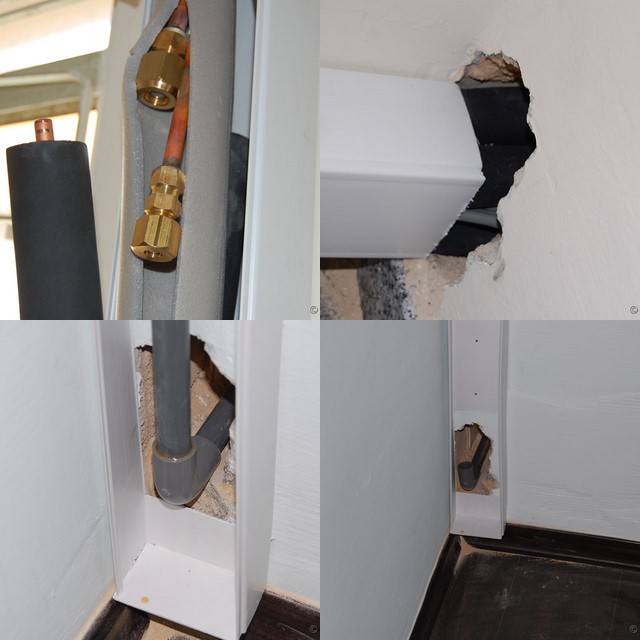
So like everyone else, I paid up meekly for 1/2-inch Armaflex insulation foam because I know full well the consequences of  not having the proper insulation foam for my aircon trunking.  But not before I checked that I got what I paid good money for.

Quality Materials Used
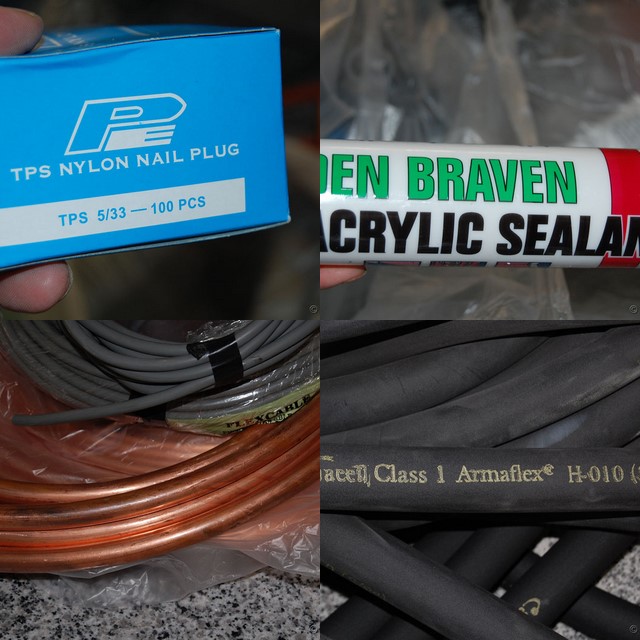
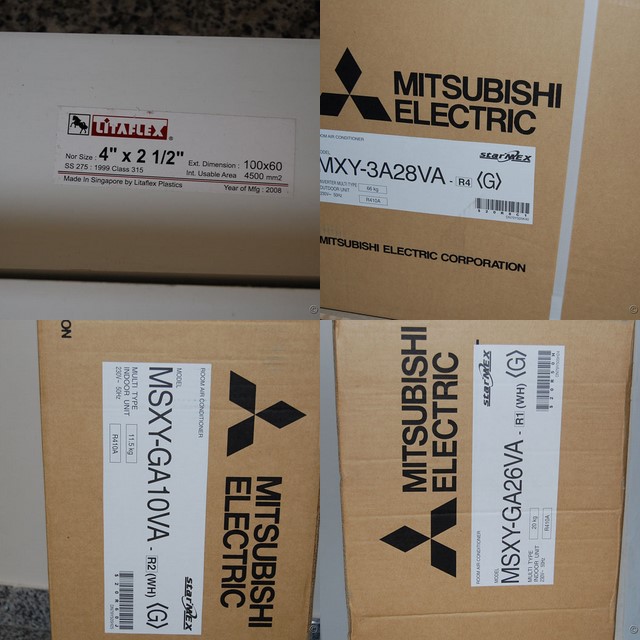
As the materials used will be concealed inside the trunking, check the materials for quality and specifications, such as 1/2-inch Class 1 Armaflex insulator foam, before installation commences.  Armaflex is a registered trademark of Armacell, the world's largest and foremost insulation manufacturer.


Indeed, I found that Armaflex is the registered trademark of Armacell, the world's leading producer of insulation foam.  Armacell is the global market leader in foams technology. The company invented Armaflex®, the world's best known and most trusted trademark in elastomeric foam insulation. With more than 50 years of experience in foams, Armacell manufactures foams and expanded rubber products for automotive, industrial, sports, leisure and packaging industries -- in addition to mechanical insulation.

Class '1' Armaflex (Fire Performance, BS 476 Part 7 1997) is a dust free, fiber free CFC & HCFC free (ozone depletion potential of zero), flexible, black, closed cell, elastomeric nitrile rubber insulation providing a highly efficient method of controlling condensation and insulating against both heat loss and heat gain.

Placement of Air-con Units
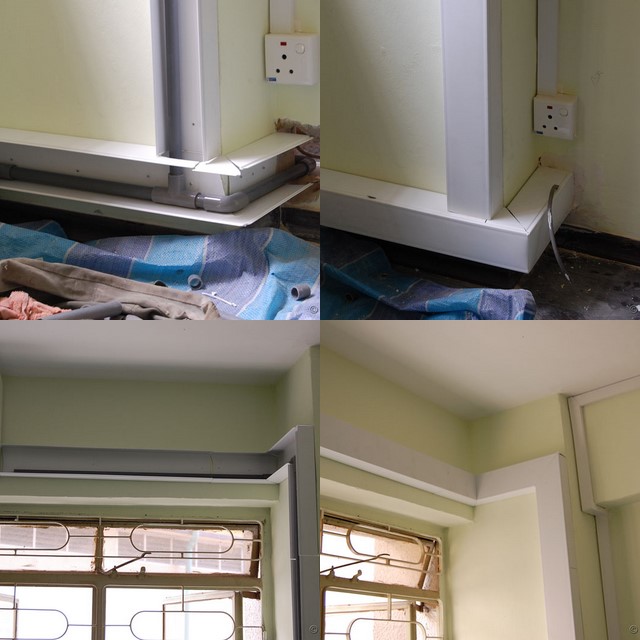
Before you call in the aircon installers, you should study your apartment interior to decide where and how you want to run the trunking.  This is important particularly for those living in flats where the trunking is exposed and not concealed behind a partition board or wall.

Living Area: MSXY-GA26VA Starmex 26,000 BTU Inverter R410A Fancoil Unit
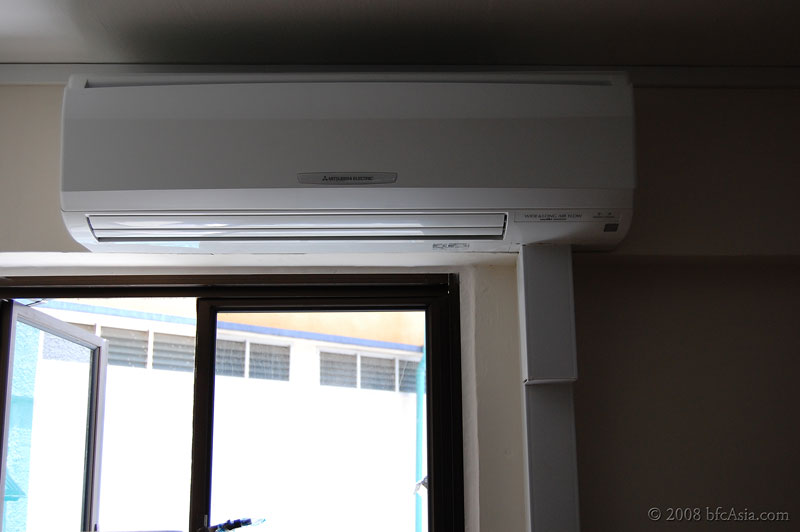
To minimize the risk of water flowing back into the fancoil unit and dripping onto the floor, I generally prefer to run the trunking along the bottom near the floor line.  You should also check that the installer uses a water or spirit level to ensure the proper gradient of the piping so that water flows properly to the drainage outlet in the bathroom.

To minimize heat gain, the fancoil units, where it is practical to do so, should be sited as near as possible to the compressor.

Finally, place the fancoil so that the blower fan blows directly into the area you wish to cool.  A central location along the wall near the ceiling is preferred to a corner location in this respect.

You don't need to locate the 15-amp socket near the compressor but you need to locate the 15-amp socket along the trunking so that the electrical wire could be concealed in the trunking.


Drainage pipe
Don't let the installer decide without seeking your direction on where and how to run the drainage discharge pipe.  You let them be, and they will simply install wherever and whichever is most convenient for them.  In my case, I specifically directed them to install the drainage pipe so that the water is discharged as near as possible to the bathroom drainage hole.  What they had wanted to do was to run the drainage pipe to the near end, instead of the far end, of the bathroom.  The near end meant less work for the installer, and the water would flow across the bathroom floor to the far end where the bathroom hole was located.

Drainage Pipe
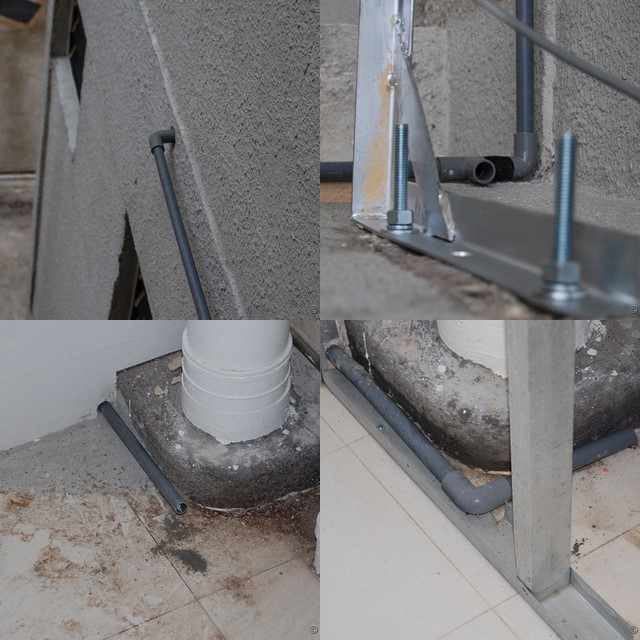
The installer used a blow-torch to soften the plastic pipe (which was pointing upwards!) and bent it downwards so that water will flow smoothly out to the drainage hole.

Installation
Usually the location for the compressor is pre-determined for you if you live in a HDB flat. Such as a specially constructed air-con compressor ledge, usually located in the kitchen yard or on an external window ledge.

Installation - getting down to work
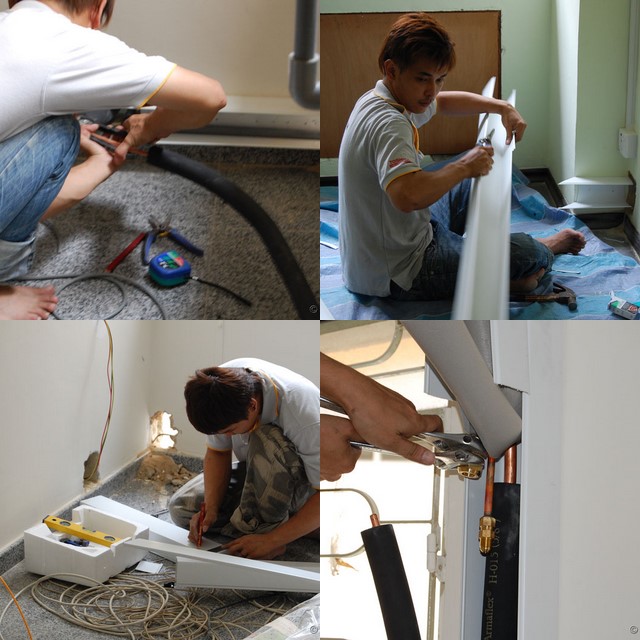
In my case, my flat was built in the early eighties when an aircon ledge was not provided for in the basic design of the apartment, and so I had to decide where to place the compressor.  I could place the compressor outside the MBR, for which HDB had provided a cut-out hole in the wall.

However, I decided to site the compressor below the window in the dining room.  That way we would not be disturbed by the sound of the compressor operating in the night outside the bedroom window.  Moreover, the dining room location was less exposed to direct sunlight and more "centrally" located to all the fancoil units.  This resulted in a shorter trunking (read: less heat loss, more effective cooling) between the fancoils and the compressor.

Some have advocated placing the fancoil so that the cool air does not blow directly on the occupant(s).  This is bad advice!  Very bad advice indeed. You know what? I site the fancoil so that the cold air blows directly onto the occupants who wanted cooling!

The purpose of installing an aircon is to cool down the room quickly and effectively, and then to maintain the room at an optimum and comfortable level i.e. neither too hot nor too cold.  If the air con doesn't blow directly at the space you want to cool, but instead blows the cold air somewhere else, it will take a longer time before the room becomes comfortably cold enough for you.

In the past, aircons did not have vanes that automatically direct the airflow around the room, so that once the room had cooled down, cold spots would develop as the aircon continued to blow directly at the same spot in the room.

Or even where the vane swung from side-to-side, the occupants would feel frigid and uncomfortable when the cold air continued to blow on them after the room had cooled down sufficiently.  This was because there was no mechanism to reduce the airflow automatically and to reset the room temperature automatically once the room has reached the desired (cold) temperature.

Today, however, air cons are designed with a host of new innovations: not only do aircons have vanes that swing left and right, they also rotate up and down.  And some are linked to fan motor speeds: to "push" out a higher or lower volume of cold air as the occasion warrants it.

I mounted the Starmex fancoil unit, for instance, directly above the MBR window, which was a short distance to the compressor. Now, with this placement, if I feel uncomfortably hot as I go to bed, I could turn on the aircon, and it will immediately shoot out a direct blast (because I set it so) of cold air to cool me down fast as I lie on the bed. Refreshing!

MBR: MSXY-GA10VA Starmex 9,000 BTU Inverter R410A Fancoil Unit
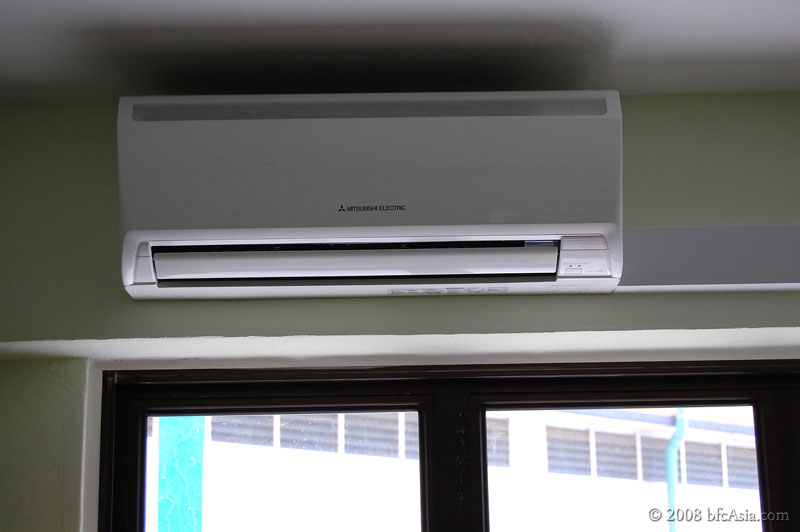
Few minutes later, after my body has cooled down, I will set the remote control to "I Feel.." auto operation mode.  That automatically sets the aircon to produce the optimum room condition for sleep with a one-touch operation.  And I could not hear any motor sound from the fancoil, only feel the cool air.  Amazing! I really love my Starmex !


Related Posts
1 Choosing an Air Conditioner
2 Energy Saving Tips for Air Conditioners
3 Installation & Placement of Air-con Units
4 Air Conditioner Cooling Algorithm

8 Energy Saving Tips for Air-Conditioners

Related Posts
1 Choosing an Air Conditioner
2 Energy Saving Tips for Air Conditioners
3 Installation & Placement of Air-con Units
4 Air Conditioner Cooling Algorithm

Before you decide on your choice of air-conditioner, it is useful to know the following energy-saving tips from the NEA website:

1. The air-conditioning unit achieves cooling by removing heat from the room, consuming electricity in the process. Thus, reducing the amount of heat gained by the room will reduce the amount of electricity consumed for air-conditioning. Consider using sun-shading devices, blinds or solar control film to keep out heat gained by the room through windows.


2. The size, or cooling capacity, of air-conditioning units is usually specified in terms of Btu/hr or kW. (1 kW = 3410 Btu/hr) Ensure that the air-conditioning unit is properly sized to meet the amount of cooling required, as oversized or undersized air-conditioning units can cause reduced comfort and operate inefficiently.

3. Multi-split units are generally more energy efficient than separate single-split/ window units in air-conditioning multiple rooms simultaneously. Consider a multi-split units if you usually require air-conditioning in more than one room.


Starmex Multi-split Inverter Aircon rated 4-Stars by NEA

4. The thermostat senses room temperature to regulate the operations of the air-conditioning unit. Avoid placing lamps, TV sets, or other heat generating appliances near the air-conditioning thermostat, which may cause the air-conditioning unit to operate longer/harder than necessary.


5. The energy consumption by the air-conditioning unit increases with the difference between the room and outdoor temperatures. Set your thermostat as high as comfortably possible. You may wish to consider thermostat setting of 25°C.

6. Dirty air filters impede airflow, leading to increased energy consumption. Check the air filters once a month and clean or replace them as necessary.

7. Besides the air filters, the condition of other components of an air-conditioning unit (such as the refrigerant, pipes and motors) also affects its efficiency. You may also wish to consider regularly servicing your air-conditioning units.

8. Direct sunshine on the air-conditioning unit's outdoor heat exchanger decreases its efficiency. Consider shading the air conditioner where necessary, but do not block the airflow.

Related Posts
1 Choosing an Air Conditioner
2 Energy Saving Tips for Air Conditioners
3 Installation & Placement of Air-con Units
4 Air Conditioner Cooling Algorithm

How to Choose: Air Conditioner

Related Posts
1 Choosing an Air Conditioner
2 Energy Saving Tips for Air Conditioners
3 Installation & Placement of Air-con Units
4 Air Conditioner Cooling Algorithm

Basic Considerations
Inverters or Non-Inverters?
Some sales people will tell you that aircons using non-inverter technology are more reliable and/or cheaper to maintain and repair than inverter aircons. Or that R22-based aircons cost less to maintain because the R22 refrigerant is cheaper to refill than the new R410A refrigerant.

Don't believe them.

Inverter technology today is highly advanced and compressors with inverter operate more efficiently and at lower energy costs. Inverter air-cons are therefore more efficient in energy utilization and saves you money, an important consideration as oil prices and electricity rates continue to rise. Rather than repeat what the experts are saying, I'll give you the links so you can learn why you should buy aircons using inverter technology:

R22-based or R410A-based Aircons?
This is a no-brainer: go for the newer R410A-based aircons. Why? Simply because whether you like it or not, R22-based aircons are being phased out! The dealers

know that, and whether they admit it or not, they have to unload R22-based aircons on unsuspecting and ignorant consumers, otherwise they will incur huge losses on unsold old stocks. So they tell you half-truths like "...oh, the R410A types are more expensive to refill... R410A-aircon costs more to repair.. etc, etc..."

Sure, they may be more expensive to refill initially, but as time goes on with the phasing out of R22-based aircons by 2015, it will be prohibitively expensive (or even impossible) to get R22 liquid refrigerant for your R22-based air cons!

So don't be conned!

Energy Efficiency
Of all the major appliances in the home, aircons and refrigerators consume the most energy in the monthly electricity bill. Half to two-thirds of the energy consumption of a typical household in Singapore goes to operating air-conditioners and refrigerators, hence households are urged to choose energy efficient appliances when buying such goods. According to the National Environment Agency, a household choosing a 3-tick rather than a 1-tick air-conditioner can save about $500 annually through reduced electricity consumption.

The Tick Rating is defined by the NEA as follows:

Air-conditioners
Type
Minimum COP 100%1 (W / W)
No. of Ticks
0
1
2
3
4
Casement, window, single-split (non-inverter)
<>
> 2.5
> 2.78
> 3.2
N/A
Multi-split (non-inverter)
<>
> 2.64
> 2.92
> 3.34
N/A
Split type (inverter)2
  • COP100%
  • Weighted COP 3
N/A<>
N/A> 2.64
N/A
> 2.92
> 3.06
> 3.34
> 3.34
> 3.76
1 COP 100% is defined as the ratio of total cooling capacity to effective power input at full load cooling capacity
2 For split (inverter) type air-conditioners, the model shall meet both the minimum COP 100% and weighted COP3 Weighted COP = 0.4 x COP 100% + 0.6 x COP 50%


Electrical Issues
Older flats built by the HDB have a limitation on the amperage of the aircons that can be installed. My flat has such a limitation, and the aircon load is limited to a maximum of 8.5 amperes only.

However, the dealer told me it is unlikely for multi-split units to hit the maximum amperage ceiling (i.e. power usage) and asked if I was prepared to authorize him to set the compressor

maximum current load to 11 amperes. Obviously I agreed because that would give me higher cooling capacity when the occasion demands it. I didn't think all 3 fan coils would be switched on at the same time as there are only two persons living in the hdb flat.

You would need to run the electrical wiring for your apartment before the installer comes to fix up the aircon. Without any source of electricity he would be unable to test the aircon for correct and proper operation after the installation.

Finally, you could locate the 15-amp socket for the compressor anywhere, as long as the socket is near the aircon trunking, so that the cable could run and be hidden inside the trunking itself. Thus I have the 15-amp socket located inside the MBR, although the compressor is placed outside the window of the dining room.

Cooling Capacity
OK, once you have decided what brand / type of air-con you want to install, you need to know what (cooling) capacity is required to cool down your space, be it the bedroom, dining, study or living room, etc.

Some dealers have their own formula. Obviously the volume of the space, rather than simply the area and outside ambient temperature, play a part in determining the cooling capacity required, but the following rule of thumb seems to work for me:

Area (Length x Width) X 65 = BTU/hr

E.g. Room size 10ft X 10ft = 100 X 65 = 6,500BTU/hr.

Coming soon..
Understanding the Technical Specs
i.e. How to Read the Starmex Technical Table


Related Posts
1 Choosing an Air Conditioner
2 Energy Saving Tips for Air Conditioners
3 Installation & Placement of Air-con Units
4 Air Conditioner Cooling Algorithm
 

Copyright © 2008-2011 bfcAsia - All photos and contents are copyrighted material of shunFoto.com • All Rights Reserved