Showing posts with label kitchen tips. Show all posts

Kitchen Tips: Spice Storage

Credit: How to store spices

SPICES
Fresh spices make your cooking taste better, no doubt about that. Spices bought

from the retail outlets come in plastic packs. They may be fresh, dried whole spice, spice seed, grounded into powdery form or as spice paste. Before you use the spice, check for molds in spice packs - a sign that moisture has seeped in and spoilt the spice.

The basic principles to store spices are:

1. Keep in airtight containers.
2. Keep them away from heat source and direct sunlight.
3. Best - refrigerate them in airtight containers.

Kitchen Flooding !

Water began to flow into kitchen..*sob*

...after 45 minutes.. *wring hand*

...next morning, after blockage was cleared... *wrinkle nose*
Our lovely kitchen was flooded some time ago.*heartache*

Many of us will encounter that situation at one time or another. In this article we shared what we did to solve our drainage problem, in the hope our experience will be useful to you.

***

So, what would you do when you encounter a drainage problem? Should you call the hdb town council? Or managing agent if you live in a private apartment? Or your own plumber?

You call the town council if the hdb common service pipe is chocked. But you call your own plumber if the blockage is in your internal kitchen pipe. Knowing whom to call will save you time, heartache and money.

Here was what we did:

We began by investigating the cause of the flooding. We recalled the last time we flushed water down our kitchen sink was barely 40 minutes ago; the water had drained from the sink without any problem. We were therefore certain no waste matter clogged our kitchen drainage pipe.

Drawing of common drainage pipe:

Take a look at the drainage pipe drawing. If blockage had occurred in the common drainage pipe, the water level discharged from all flat units above our unit level would rise and flow into our unit. That won't occur if the blockage occurred in our kitchen pipe - the water would simply stagnate until the blockage was cleared. Luckily we recalled that we last used the kitchen sink about 40 minutes prior to the flooding, which meant the common drainage pipe was blocked and caused our kitchen to be flooded!

That must be the reason, we concluded! We called the town council.

* * *

Note: We also regularly maintained our drainage piping system. You should too - find out how in a related post.

Also note that the kitchen drainage system is separate and distinct from the bathroom / toilet drainage system. Therefore you can rule out your toilet drainage pipe if only your kitchen is flooded.

* * *

Our town council ("TC") responded quite swiftly to our call. The TC maintenance supervisor and the area manager visited our premises to check on the flooding situation. After listening to our explanation and doing some tests of their own, they agreed with our assessment. It was late in the evening,

Next morning a plumber and his assistant came. They asked to view the common drainage pipe. Luckily - although we had concealed the common drainage pipe behind a partition wall - we could open the partition doors once the fridge was moved away. See how our kitchen drainage system was concealed behind a partition.

Flexible pipe to probe for obstacle

After gaining access to the common drainage pipe, the plumber used a long flexible "stick" to probe / clear any waste matter that may have caused the blockage. He confirmed there was indeed a blockage, and that the blockage was in the common drainage pipe!

Inspecting the flat unit below

Next, he went to inspect the unit below our flat. The unit was tenanted to a foreign family.

True enough, the ceiling in the unit below had flooded copiously the night before. The tenant told us he had called the landlord owner but the owner had told him to solve his own problem!!

The plumber got down to work. He decided to cut the common drainage pipe under the kitchen sink after ascertaining the location of the blockage.

After the pipe was cut, he extracted a piece of clothing from the grimy mess. That was the cause of the blockage!

Urrggh..so gross, the cause of the blockage!!

Less than 30 min later, the blockage was cleared. Hooray!

What a mess

How in the world could clothing end up in the common drainage pipe ???!!!

Kitchen Ideas - Worktop Protector

Imagine our dismay when we learnt that most modern worktops are neither heat nor stain-proof. Instead the manufacturers used terms like "heat-resistant" and "stain-resistant" to sell their products. To us that is as good as saying the worktops are affected by heat and attract stains.

In future we would likely consider solid wood worktops. Properly sealed and finished, solid wood worktops are probably the most heat-proof and stain-proof worktops we know, and hence easy to maintain.

But for the time being, what can we do to ensure our new acrylic worktop doesn't show stains or heat rings after hot pots have been placed on it?

We don't like those metal trivets with legs sold at hardware stores. They rust and are ugly, and you need several sizes to place your pots and pans. Neither do we like round or rectangular woven rattan or bamboo pads. Usually they are somewhere else when we need them! And lest we forget, be mindful the pads stain the worktop when wet as the pads are usually dyed and brightly colored.

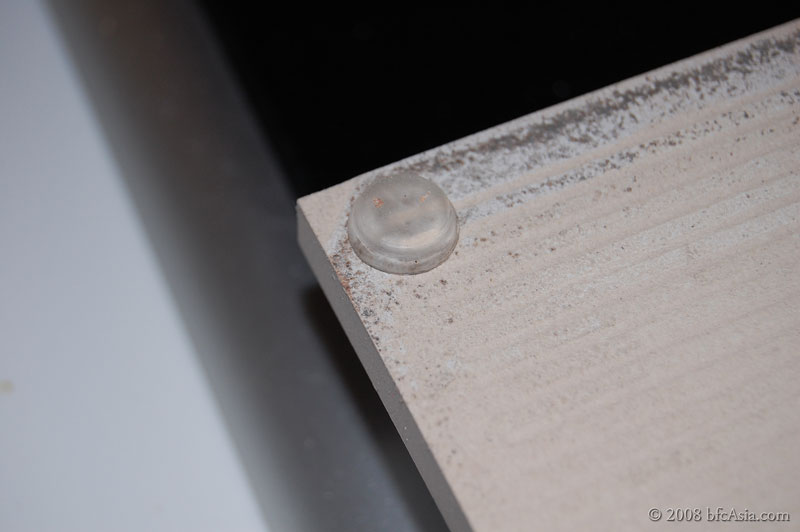
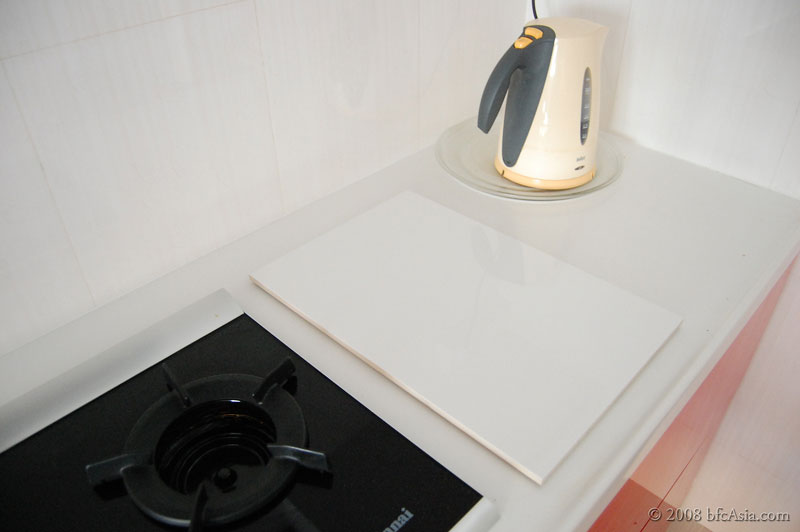
So we got our tiler to smoothen the edges of a left-over 45cm x 30cm white wall tile, attach plastic pads onto the four underside corners, and viola, we've got our worktop protector !

Stick rubber or plastic disks to each underside corner of the tile


Worktop protector made from left-over wall tile


If your renovation has already been completed and the tiler is no longer around, simply use a whetstone (aka knife sharpening stone) to smoothen the sharp edges of the tile. We learnt that from our glass-cutter. He had used a whetstone to smoothen the sharp edges of glass panels he had cut. Very effective!

Kitchen Ideas - Waste Bin

We always wonder how other working couples organize their kitchens, particularly with regard to the "little" things. Little things such as the waste bin, the wiping rag, chopping board, dish detergent, scouring pads, etc. Because those items determine whether your kitchen is cluttered and disorganized, or neat and functional.

Waste Bin

For instance, what do you do with your kitchen waste? Do you use a waste bin and clear it only at the end of the day? Where do you place the waste bin -- inside a cabinet, or simply at a corner of the kitchen floor?

In our old kitchen we had one of those plastic bins that opened by stepping on a pedal. At first we placed the

bin on the floor near the kitchen sink, but soon found it unwieldy to open the bin using the pedal. Subsequently, after we stopped using the bin pedal, and to keep the kitchen tidy, we placed the waste bin inside the sink cabinet.

Not very practical. To throw kitchen waste, we had to open and shut two sets of "doors" - the sink cabinet door and the lid for the bin.

Finally we put away the plastic bin and simply use a waste basket lined with a plastic bag. That was placed on the floor near the sink. Untidy, yes, and a sore sight for the eyes. But it was practical.

For our new kitchen we decided to look at solutions available in the market, such as those offered by Ikea and Poh Joo.

Ikea, Blum and Hettich all provide purpose-built bins for kitchen waste that are placed inside deep drawers under the worktop. The idea is neat and quite presentable, but not practical in our climate.

In our humid and hot climate, we think kitchen waste kept in bins inside deep drawers will go bad very quickly, producing an offensive odor that is difficult to remove inside deep drawers.

Here in Singapore our waste bins are cleared daily by environmental trucks, but in Australia the local council truck clears the rubbish bin once a week because the cool weather permits that.

We also saw a built-in waste bin for the worktop as presented by Poh Joo:

Waste bin with lid built into worktop, S$150 from Poh Joo

Open bin with removable ring removed

Removable ring holds plastic bag to the rim


Poh Joo's waste bin came complete with an outlet plug at the bin bottom that connects to a outlet pipe below the worktop. That allows the bin to be washed easily when the waste has been cleared.
OUR SOLUTION?
None of the commercial solutions appealed to us.


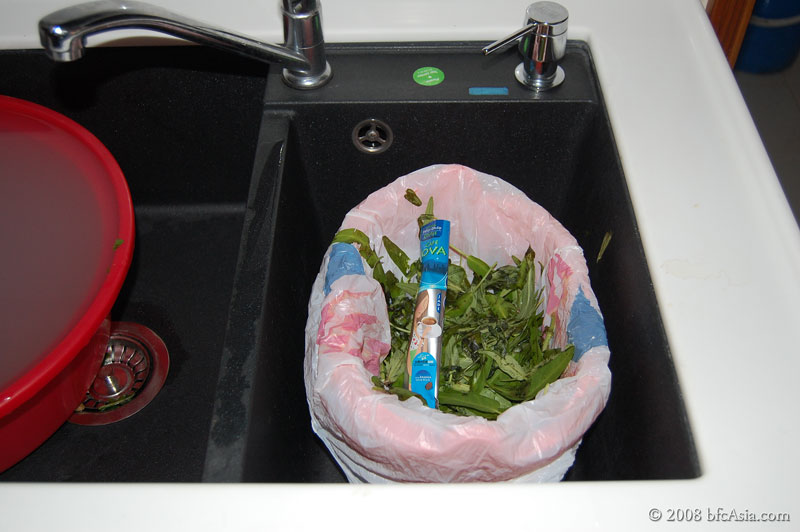
Our idea is simply to use the second bowl of a two-bowl sink as the receptacle for our kitchen waste. Our waste bin is a plastic container with a plastic bag in it, placed in the smaller bowl of the sink, like so:
Waste from food preparation placed into plastic bag

Plastic container cleared after food preparation

Placing the waste bin at the sink near to the Food Prep Zone is logical, because that's where the waste originates.

If desired, we could put the waste bin on the worktop as we prepare the food. When food preparation is completed, simply throw the plastic bag with its waste content into the rubbish chute, wash the plastic container under the tap, and we are done!
 

Copyright © 2008-2011 bfcAsia - All photos and contents are copyrighted material of shunFoto.com • All Rights Reserved