Showing posts with label hob. Show all posts

Review: Rinnai 2-Burner Hob RB-2CG

Review Series
1: Blanco Sink - 3 stars
2: Rinnai Gas Heater - Not Rated
3: Fujioh hood FX-900 - 5 stars
4: Rinnai Tumble Dryer RDT-600CG - 5 stars
5: Rinnai Oven RBO-7MSO - 3 stars
6: Bellari Liquid Dispenser - 1 star
7: Rinnai 2-Burner Hob RB-2CG - 5 stars
8: TOTO Omni Toilet Bowl- 5 stars
9: Asuka Acrylic Worktop - 2 stars
10: Premier laminated floor tiles

Related Posts
1 Using the Rinnai Burner Hob
2 Rinnai Inner Flame Technology
3 Review:Rinnai 2-Burner Hob RB-2CG

Preamble
In appreciation of your support, we now provide a series of updates giving our verdict and recommendation on which appliances and equipment we had bought that turned out to be very good buys. Or bad buys. We won't hesitate to give zero or 1-star for products that don't work as expected.

A word about the Review
Our Review is different from other reviews that you read on the Net: we're not armchair reviewers. We bought and installed the product for our own use. No one sponsored us to endorse the product. And we only gave our verdict after at least one year's usage. Obviously, we'd tell you sooner if a product didn't work or performed poorly soon after purchase.

We invite you - if you have bought, installed and used the product to tell us your user experience, particularly after using the product for at least a year. Whether positive or negative, please give us your feedback. Oh, don't forget to provide your Renotalk user ID and photos of your kitchen so we could verify you're a bonafide user of the product.


To kick off the series, we start with the Rinnai 2-burner hob with the Schott ceran glass top.
Rinnai 2-Burner Hob, Model RB-2CG

Verdict: 5 out of 5 stars - Highly Recommended

Having used the hob on a daily basis over the past 20 months, we must say we're really really impressed with this hob! Our reasons are as follows:

Easy and quick to clean
Asian cooking - like ours - tends to be very greasy, and we found the Rinnai

glasstop very easy to clean. The burners are mounted below the glasstop, giving a flat surface over the entire cooktop once the small but robust trivets are removed.

Also, the round trivets are only a bit larger than the burners. After cooking at the end of the day, we simply chuck the 2 small trivets into the sink, pour hot water over them, and viola! the trivets are cleaned! That simple - because each burner has its own trivet and the small size of the trivet makes handling and cleaning them a breeze.

Next, we used a soapy dish towel to wipe the entire glasstop surface, removing all cooking splashes, oil and grease on the cooktop. Took us less than 30 seconds.

If need be, we pulled or plucked up the control knobs, exposing the areas beneath the knobs for cleaning.

All very quick and simple to do.

Rinnai 2-Burner Hob


The Insides

Why two burners?
Our previous Elba hob had 4 gas burners and 1 hotplate that ran on electricity. The hob looked impressive, but functionally, we made a bad choice. We found that

most of the time, we cooked with only 1 burner, and seldom went beyond two.

The Elba hob came with 3 trivets. Two large trivets, each spanning two burners, and a smaller trivet (No: 3) that covered the area between the two large trivets, providing a small space to rest hot pots and sauce pans.

We had a hard time cleaning the Elba hob. First, the 4 burners (and hotplate) were mounted on top of the hob surface, and each burner had a sunken rectangular area to catch spills, making for an uneven surface. Cleaning such a surface - obstructed by the top-mounted burners and separate sunken areas - together with the 3 large and clumsy trivets, took a lot of time and effort, and was a real pain. Thus what should have been a daily event became a weekly chore as we put off cleaning the hob daily.

As you can imagine, we chose a 2-burner model for our Rinnai hob.

That cuts down tremendously on the cleaning required, and also provides more cooking space as the burners are spaced out. Aesthetically, the hob looks minimalist and elegant with only two burners, in our opinion.

The Flame
Rinnai's inner flame technology really works! You can read about it here.

The flame burns hot, really very hot! Golly, we could even feel the heat at quite a distance from the hob. The very hot fire meant cooking dishes that required wok hei or umami was not a problem for us.

In fact, the burner was so very hot that we burnt more than a couple of stews and soups when we left the stew unattended. We then had to use a lot of elbow grease and effort to scour and clean the blackened pot or pan.

So if you must use the highest flame setting on the Rinnai, do not leave the stew (as we did) to do something else! Or before you know it, the Rinnai burner will burn the stew to a crispy / crusty black mass!!

The fire is still very hot when you use a medium-low setting. So that's the setting we now use to cook our meals.

To see how hot the fire was, we once turned down the flame so low you could hardly see the flame. Yet a stew we were cooking on the stove continued to simmer merrily. We couldn't do that with our previous Elba (and more ex-) hob.

As the burners are mounted below the glasstop and the jet of burning gas gets directed inwards in a fierce spiral - a very hot and intense vortex of flame is created that is not easily extinguished nor affected by wind on a rainy day. Wonderful!

The Control Knobs
We had initial problems firing up the burner. Rinnai did not provide any instruction on the control of the knobs. So we had difficulty to ignite the burner flame.

We had no issue, however, to turn off and shut down the flame after we had succeeded in turning on the burner.

Later, we discovered how to turn on the burner flame effortlessly! It was simple, really!

To turn on the flame, you need to turn anti-clockwise (follow the printed arrow) while pressing the knob down until you hit resistance, at which point the gas ignites and the fire comes on. But don't let go of the knob yet! You continue to press down the knob and turn against the resistance - using minimal and gentle force - until you hear a click. You then turn back the knob slightly - actually it springs back to the initial point of resistance. At that point you release the knob - and the burner will continue to burn.

It takes some practice, but you will get the knack of it in no time.

Obviously, Rinnai's method to turn on the flame is ingenious. Because that will prevent any inquisitive child to accidentally

turn on the fire, perhaps getting burnt in the process.

Incidentally - the battery that came with the hob still works flawlessly to ignite the gas, some 20 months after the initial installation. In time the battery will need to be replaced. Also, the special ignition element built into the burner ring will fail one day - we were told by the sales staff that would happen after the hob has been in daily use for some years.

To conclude, we certainly made a wise choice with the Rinnai RB-2CG model - Highly Recommended.

Update: 20-Nov-2011
Yesterday I succesully cooked biryani chicken in a heavy-bottomed pot (WMF 20cm High Casserole) on the hob's lowest flame setting. The chicken pieces were covered with drained basmati rice that was 50% pre-cooked in boiling water. As I did not add water to the pot, I needed to set the fire to a very, very low level to cook slow-cook the meat and rice in a closed environment of water vapor emitted from the heated rice grains. I discovered to my surprise the Rinnai hob was able to set and maintain the flame at a very very low level it was barely visible, without the wind blowing it out! The flame continued to burn hot and strong, wind or no wind. And my biryani chicken turned out perfectly. Everyone exclaimed my biryan chicken was so delish!

My point is - if you set burners without the Rinnai inner-flame technology to a low fire , it will be snuffed out by wind sooner or later. Set to a very low level? Forget it - those burners simply aren't capable of that, if my experience with my Elba burner is enough to go by.

Oh, if you are interested in cooking biryani chicken, follow the full recipe on my blog here. Aside from photography, cooking is my other passion!

Related Posts
1 Using the Rinnai Burner Hob
2 Rinnai Inner Flame Technology
3 Review:Rinnai 2-Burner Hob RB-2CG

Review Series
1: Blanco Sink - 3 stars
2: Rinnai Gas Heater - Not Rated
3: Fujioh hood FX-900 - 5 stars
4: Rinnai Tumble Dryer RDT-600CG - 5 stars
5: Rinnai Oven RBO-7MSO - 3 stars
6: Bellari Liquid Dispenser - 1 star
7: Rinnai 2-Burner Hob RB-2CG - 5 stars
8: TOTO Omni Toilet Bowl- 5 stars
9: Asuka Acrylic Worktop - 2 stars
10: Premier laminated floor tiles

Using the Rinnai Burner Hob

Related Posts
1 Using the Rinnai Burner Hob
2 Rinnai Inner Flame Technology
3 Review:Rinnai 2-Burner Hob RB-2CG

Rinnai Burner Hob RB-2CG
After Citygas turned on the gas supply to the apartment, I tested the Rinnai burner.

Initially the burner failed to light as there was no spark ignition, no matter what I did. I called Rinnai service center (Tel: 67489011) and a lady named Sarah attended to me. She suggested replacing the battery. So simple solution, made me embarassed! I took out the battery and put it back again. That fixed the problem. Maybe the contact points were bad. I turned on the burner.

My immediate reaction was: "wah, so hot...!"

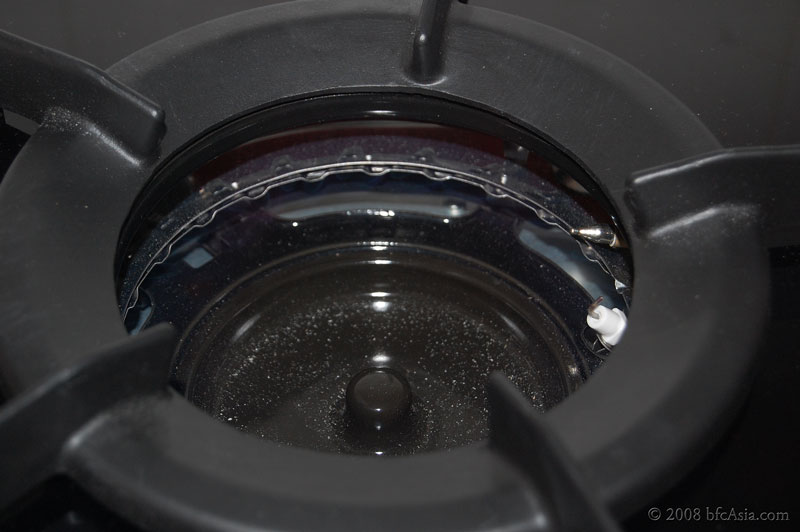
Inner flame burner really burns hot!

Seems the inner flame burner gives a hotter fire, and I could feel the heat of the flame even as I stepped back. The reason is obvious: the burner puts out a vortex of fire that is focused and directed towards a smaller spot, unlike conventional burners where the flame is directed outwards around the rim.

Rinnai inner flame burner

Incidentally, Sarah from Rinnai confirmed the ceran glasstop, same as the hob itself, is guaranteed for only 1 year. This was contrary to what the Rinnai rep at the

Citygas showroom told me: she said the Schott ceran glasstop came with lifetime warranty, when I enquired about breakage. A replacement would set me back $300, though Sarah mentioned she had not received any customer complaint yet of the glasstop shattering. Maybe that was because she was only in her job for 9 months. Well, time will tell.

In any event, despite no lifetime warranty for the ceran glass, my impression of the inner flame hob is still positive. I don't think Rinnai will continue to produce the ceran glasstop model for sale if the breakage rate has been bad. We shall see.

ADDENDUM
15-May-08 : Some readers wrote in to ask our experience with the Rinnai inner flame hob burner. After using the burner for two weeks now, we can say - we love it!

With only two burners on the hob, the hob was a breeze to clean. The trivets were easy to take out and wash under the tap if needed, and overall it was easy to maintain the hob.

Owing to its inner flame vortex, we found we could turn the flame down to a very

low level without extinguishing the flame, or worrying that a sudden gust of wind would blow out the fire. The inward directed and focused nature of the vortex jet simply kept the fire going. Simmering under low heat was not an issue.

Secondly, maybe it was our imagination, but we felt water boiled quicker and Basmati rice definitely cooked much faster compared to our previous Elba burner. The fire was hot and the heat could be felt from a distance.

Maybe it was too soon to make a call. But we found the Rinnai hob burned very cleanly, with no soot. All our pots and pans showed no sooty bottom after cooking on the Rinnai hob with the inner flame. We think Rinnai's vortex jet "pulls" in air to burn the gas more completely. As a result the fire is hotter and burns with a blue flame. Gas that is incompletely burned will burn with a yellow flame.

Third, it seemed the Rinnai hob was made specifically with Asian cooking in mind. Woks could be placed directly on the Rinnai burner without requiring a wok trivet, like with my old Elba hob. That made for a cleaner burner hob that is easier to keep clean.

The only thing that had some issue was turning on the burner. We had to turn the knob fully anti-clockwise, hold for a few seconds, then release the knob gently. Otherwise the flame would be extinguished when the knob was released. It needed getting used to.

UPDATE: 14-May-11
Several readers pm'ed they were a bit disconcerted at the 'apparent' difficulty in turning on the fire when they tried to use the hob. I then explained an easy method to turn on the flame:

1 - Push down the burner flame knob and gently turn anti-clockwise until you reach resistance i.e. you feel the knob cannot be turned further. That resistance signals the "end" of the knob-turn but do not let go of the knob yet, continuing to pushing it down.

2 - As you continue to push the knob down, turn a bit more anti-clockwise until you meet resistance again. At that point you then turn back the knob in a clockwise direction until you hear a "click" sound. That' a "locking" indication you've turned on the fire successfully.

With the above procedure you should have no difficulty in turning on the fire!

Update: 20-Nov-2011
Just last week I cooked biryani chicken in a heavy-bottomed pot (WMF 20cm High Casserole) on the hob's lowest flame setting. The chicken pieces were covered with drained basmati rice that was 50% pre-cooked in boiling water. As there was no water in the pot, I needed to set the fire to a very, very low level to cook slow-cook the meat and rice in a closed environment of water vapor that was emitted from the heated rice grains. I discovered to my surprise the Rinnai hob was able to set and maintain a very very low fire it was barely visible, without the wind blowing it out! The flame continued to burn hot and strong. And my biryani chicken turned out perfectly. Everyone exclaimed it was so delish!

My point is - if you set burners without the Rinnai inner-flame technology to a low fire, it will be snuffed out by wind sooner or later. Set to a very low level? Forget it - those burners simply aren't made for that low flame, if my experience with my Elba burner is anything to go by.

Oh, if you are interested in cooking biryani chicken, follow the full recipe on my blog here.

Next Post
2 Rinnai Inner Flame Technology

Review Series
1: Blanco Sink - 3 stars
2: Rinnai Gas Heater - Not Rated
3: Fujioh hood FX-900 - 5 stars
4: Rinnai Tumble Dryer RDT-600CG - 5 stars
5: Rinnai Oven RBO-7MSO - 3 stars
6: Bellari Liquid Dispenser - 1 star
7: Rinnai 2-Burner Hob RB-2CG - 5 stars
8: TOTO Omni Toilet Bowl- 5 stars
9: Asuka Acrylic Worktop - 2 stars
10: Premier laminated floor tiles
Rinnai Inner Flame Technology

Related Posts
1 Using the Rinnai Burner Hob
2 Rinnai Inner Flame Technology
3 Review:Rinnai 2-Burner Hob RB-2CG

Source: www.appliancedesign.com, October 28, 2003

Ignition/Burner Control: Whirly Burn

Rinnai gas cooktop (right) incorporates recessed, inner-flame burners into a Schott Ceran glass-ceramic panel to create an appliance that provides high-performance

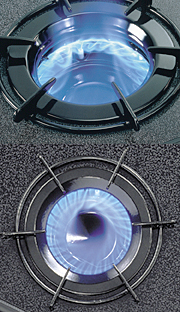
cooking capabilities with convenience and an easy-to-clean surface. A vortex of flame (bottom) is created by angling the burner ports on the horizontal plane. The swirling flame aids combustion by helping to draw air. The unique flame also assists in distributing heat evenly across the bottom of the pan.

Inner-flame burner improves heat transfer efficiency.


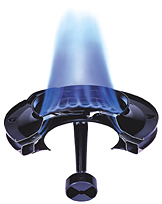
Cutaway view of Rinnai’s inner-flame burner shows how the individual flames coalesce and rise toward the center. When the cone of flame hits the bottom of a pan, it flows outward across the bottom to ensure even heat distribution and efficient heat transfer.

o o o

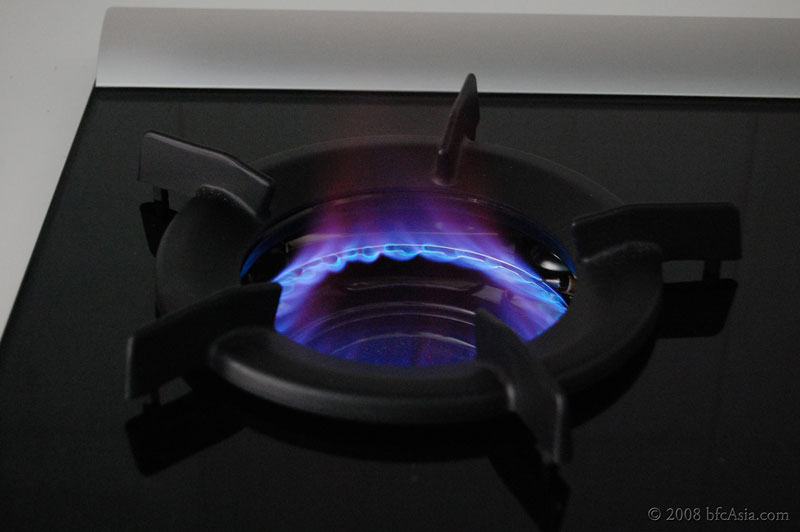
Appliance-maker Rinnai Corp., Nagoya, Japan, has turned burner design completely around with its inner-flame burner. Instead of shooting flames outward from the burner perimeter, as with a conventional burner, Rinnai’s inner-flame burner is ported so that flames shoot inward toward the center.

The purpose of the unusual design is to create a coherent, unified flame that rises under the center of a pan, then flows outward, bathing the entire bottom of the pan in flame. This approach heats the pan with greater uniformity and improves the efficiency of heat transfer from the flame to pan.

In addition to aiming the ports inward, two other design factors assist in shaping the flame. One is that the burner sits slightly below the surface of the cooktop, helping the individual flames to coalesce toward the center as they rise through a hole in the cooktop surface. Secondly, and more importantly, the burner ports are angled slightly on the horizontal plane. (See top view in lower photo.)

The effect of the flames shooting out an angle is to create a fiery vortex. The swirling flame is meant to accomplish two things. One, it assists in driving the flame outward across the bottom of the pan, helping to evenly bathe the pan bottom with flame. Two, the vortex creates a pressure drop that assists in drawing air in for combustion.

The large version of the inner-flame burner has 24 ports and delivers a maximum output of 15,872 BTUs/hr. The burners are lit by direct-spark ignition.

Rinnai originally intended the inner-flame burner to be installed into a metal panel cooktop. Instead, Rinnai began working with Schott Corp. to find a way to implement the novel burner into a Ceran surface panel.

Schott’s technical support staff worked closely with Rinnai to address a number of issues. One of the biggest was concern over how to protect the burner and other

components from spills going down the hole. Another big concern was protecting the Ceran from direct exposure to excessive heat. Schott’s engineers devised a special burner sleeve to solve these potential problems. Schott also assisted with the design of the cooktop’s framing and a ventilation grid in the cooktop which serves two purposes: one, to provide primary air supply for the burners and, two, to vent exhaust from a fish griller beneath the cooktop.

Rinnai incorporated many of Schott’s design ideas in the final production model of the appliance.

The result was a unique appliance that successfully combines a novel, high-performance burner design and a convenient, easy-to-clean cooktop surface.

Schott says that the popularity of Ceran is growing in the Japanese market because the material’s cleanability is a big advantage in a region where cooking methods involve a lot of frying.

Rinnai says the cooktop with the inner-flame burners has been adopted by many Japanese cooking schools because the burner system is amenable to cooking different regional styles of meals, including Japanese, Chinese and French.

At this point in time, Rinnai has no plans to license the inner-flame burner technology to other appliance manufacturers. — R.J.B.

o o o


We found Fujioh Japan also makes gas hobs with inner flame burners. Is it the same as Rinnai's and did Rinnai license the technology to Fujioh?


Related Posts
1 Using the Rinnai Burner Hob
2 Rinnai Inner Flame Technology
3 Review:Rinnai 2-Burner Hob RB-2CG


Copyright © 2008-2011 bfcAsia - All photos and contents are copyrighted material of shunFoto.com • All Rights Reserved