Kitchen Accessories


Sink Basket


Disk Drainer Rack


Drawer Basket

Kitchen - Glass SplashBack

Taking Measurements

On 25-April-08 two guys from L&K Aluminum & Glass Works PL came to take measurements for the glass splashback. The glass panel would be spray-painted black and cover the entire back wall of the kitchen cabinet in the photo below:

White tiled wall above burner hob will be covered with glass panel


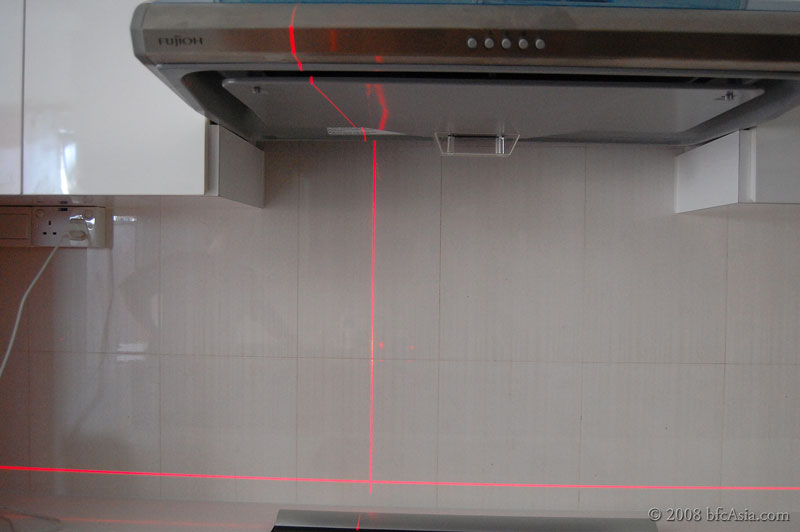
They brought a special laser beam instrument to aid them in the measurements, probably as a visual aid to assess the exact vertical and horizontal axes for the glass panel.

Laser Beam Instrument


One Month Later - Installation

Today - Thu, 22-May-08 - the L&K guys came to install the glass splash back! Why did it take L&K almost a month after the initial measurement for the installation? Well, they made mistakes.

The guys came within one week after they first took measurements on 25-Apr, bearing 3 glass pieces for the back panel. That took me by surprise.

I had previously asked the ID to remind L&K that the glass splash back should be in one single panel. Any visible seam on the glass splash back would not be a pretty sight. So what were the guys doing with 3 cut glass pieces when they were supposed to bring only one?


I called the ID. The ID assured me the factory had made a mistake. He spoke to the guys, that was followed by some hurried phone calls between the guys and the factory. Finally, the guys acknowledged the mistake, apologized, and promptly took the panels back.

Two weeks later, an L&K guy came in the late afternoon. Asked why, he said the factory had misplaced the earlier measurements! He needed to retake those measurements for the glass splashback.

All those mistakes surely cost money. Would the additional costs be charged to us? We don't have the answer, yet. The final bill for the kitchen cabinets has not been tallied. The ID assured us he would tote up all the bills and add 10% for his fee.

Trust is not something we gave easily. It has to be earned. Once lost, trust is seldom regained.

As the ID had shown integrity in his dealings with us so far, we decided to trust him and await the final bill.

Silicone applied to tiled wall


Tempered Glass
When we saw silicon applied to the entire back wall, we asked the guys what would happen if we need to replace the glass. They said they could break and remove the glass panel without affecting the tiled back wall. They assured us the glass panel would not shatter or break from the radiant heat of the burner as they used tempered glass for the panel.

Tempered Glass


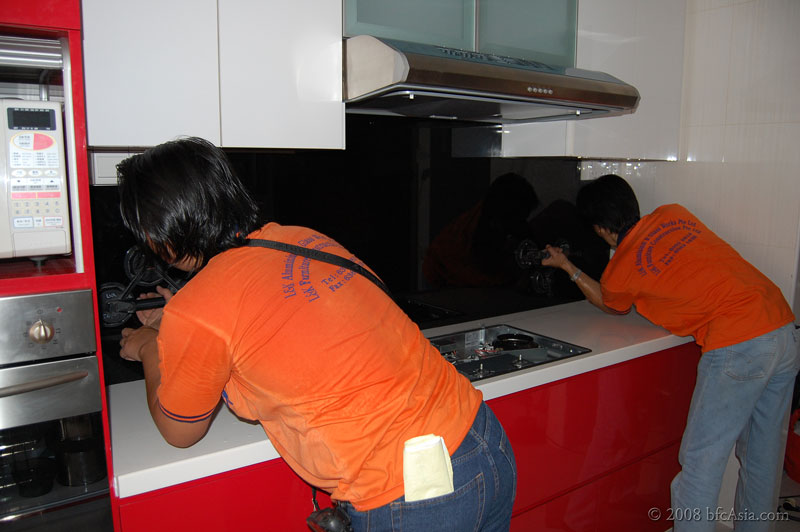
Preparing to lift the glass panel


Note how much the guy perspired during the installation process!


Finishing with silicone sealant around glass edges


"Less-than-perfect" fit of the glass panel is more apparent than real..


We viewed the completed splashback with mixed feelings.

First, the "less-than-perfect" fit of the glass panel where it meets the wall cabinet is a limitation inherent with the installation process. The glass guys had told us before they went ahead to measure and cut the glass that there would be a small line gap where the glass panel meets the top kitchen cabinets to facilitate installation. The gap space is intentional and serves to avoid scratching the base of the white cabinet as the panel is carefully and slowly "pushed" onto the back wall during the actual installation process. It was an inherent aspect of the job, and won't look too obvious or bad either. A similar 2mm allowance was made for the vertical side of the panel. We accepted the explanation.

Second, we thought the original white tiled wall looked pretty good. Maybe we should have gone for a white colored back splash instead? But then, we decided the black splash back looks quite chic and classy. So there - you decide!

Finally, would cleaning up oily residue on the back wall after cooking be easier henceforth? Perhaps it would be, we mused.

But was the extra cost worth it?

Choosing a new faucet

A reader wanted to know where we sourced our tap fittings, and whether if we had any to show on the blog. Sorry we had overlooked that. We feature them in this and the next post.

However, some comments might be in order first.

The taps and fittings shown here were those that caught our eyes, not because we approved of them, but because they looked pleasing or were unusual.

We were looking for taps and fittings that were reasonably priced, functional and looked good -- in that order. Even if the tap was made in China, but looked nice, functioned well, and priced reasonably, that was good enough for us.

So by and large the fittings shown here were priced in the mainstream range i.e. $100-$300.

Why no designer faucets?

But why no faucets and fittings from Grohe, Hansgrohe, or Hans?

Well, we had learnt our lesson.

Our old apartment had Grohe and Hans faucets exclusively. They were well-crafted, beautifully designed, and pricey.

A red-and-white Grohe kitchen faucet with a retractable hose and tap set us back S$700.

That was in 1986, when anything over $300 was considered pricey. Though perhaps not today.

And what was our experience like with the Grohe faucet?

Well, when we first turned on the faucet, the water flow was barely enough to wash the cups and plates. We thought that was normal, and attributed the slow water flow to a water filter under the sink.

However, some years later the faucet became clogged and water stopped flowing from the tap altogether. We then replaced it with a stainless steel tap bought from a hardware store.

And were we shocked -- after the replacement, water flowed through that $35 tap fitting swiftly! We were surprised. We had thought the water filter had impeded the water flow through the Grohe tap. Apparently that was not so.

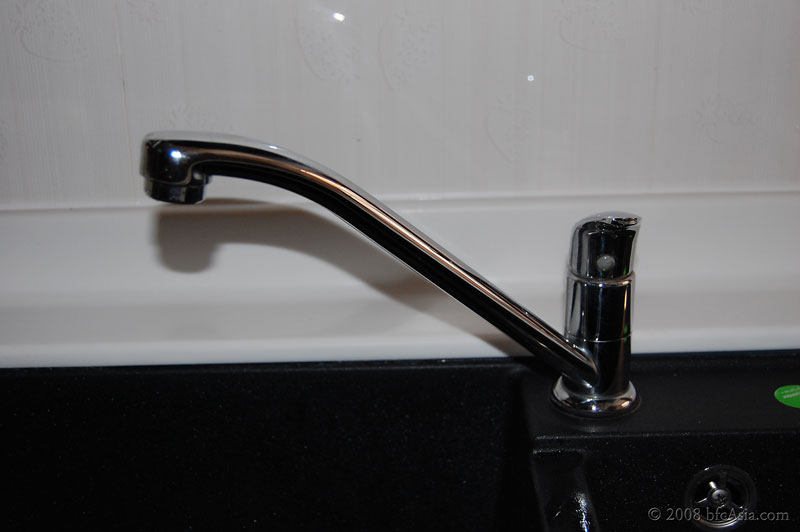
Excellent stainless steel faucet


We believed the Grohe faucet was made with a narrower bore for European markets. There most people lived on landed properties and water pressure was not an issue, unlike in Singapore where the majority lived in high-rise flats. Here water pressure was always a concern on higher floors, and faucets with narrower bores would impede water flow.

Today the situation is different. Imported taps and fittings (and sanitary ware) require PUB approval before dealers are permitted to sell them. It is likely Grohe and other European products for the Singapore market now suit local conditions.

But why tempt fate? Better safe than sorry, we decided to go for mainstream taps and fittings for our new kitchen and bathroom.

Our experience with the cheap but effective $35 tap was an eye-opener. We liked it so much we took that tap with us. It is now fitted to the new Blanco sink. And it still worked beautifully. Water rushed out when we turned on the tap.

Strong water flow from faucet


Thus you will not see any Grohe or Hangrohe tap fittings here. In any case, we had visited the Hansgrohe boutique at Mohd Sultan Rd and wanted to take photos of some designer taps for the blog. Our request to shoot was politely turned down.

We realized later, however, it was no loss actually. Some of the products seen at outlets at Jln Besar, Balestier and elsewhere looked uncannily like the Grohe or Hansgrohe products, although they were being retailed at mainstream prices! We wondered whether these were knock-offs or made under license?

How to choose taps and fittings

Do you choose the tap to fit the sink, or choose the sink to fit the tap? Well, we usually chose the sink first, then chose the tap to fit the sink. The sink is a larger piece and has greater visual impact, and is probably noticed before the tap fitting, isn't it?

When choosing taps, consider the color, shape and design of the sink.

Our old designer taps were in white enamel. Nice, but we now think stainless steel fittings are more practical.

Stainless steel taps and fittings never lose their brand-new look. Simply wash the fitting with soap and water, then wipe dry with a clean rag. And the tap looks as good as new! Even years later.

And be aware of the difference between mixer taps, meant for hot and cold water, and taps that supply cold water only.

As for tap washers, because taps are subjected to frequent and heavy usage, we went for taps that use normal leather washers, instead of the more expensive ceramic ones. Our old designer taps used ceramic discs in a cartrdige. Although they never failed us, we were told we would need to place an order if the discs wore out and the ceramic cartridge had to be replaced.

Finally, you could get taps and fittings for bathtubs, basins, and showers in a coordinated range that follows a common design theme. Some designers recommend that for a unified and consistent look throughout the kitchen, bathroom and toilet.

What will we do differently?

Related Posts
1 Mistakes Made
2 Worktop-to-Hood Distance
3 Dish Drainer Cabinet
4 What Will We Do Differently?
5 Kitchen - Mistakes
6 Plumbing - Sinks

As the major works have been completed, except for carpentry works for the living, dining and bedrooms, it is useful to review and consider what changes if any we will make if we have to redo the entire flat renovation. Useful for our readers, we hope, and certainly useful for our next renovation.

The following is our initial list. As we experience living in the renovated flat, we may have more to add.

Water Outlet Holes
Instead of creating holes along the respective kerb side to channel waste water to a central outlet, as in our bathroom, toilet, and kitchen, we would insist that the tiler create floor traps directly on the respective floors, and cover each floor outlet with stainless steel traps. Why?

Debris left behind

Well, when water flows to a central outlet as in the bathroom or toilet through kerbside holes, the debris is not flushed out effectively. We had to sweep and mop up the debris that remained behind after the water had flowed out to the hole.

It is not difficult to understand why a floor outlet is more effective than a kerb

outlet. When you pour water containing debris like hair, food particles, sand, etc onto the floor, as you would with a kerb outlet, the water and debris are first scattered all over the floor, then the water flows out to the kerb hole, leaving behind the debris.

But if you pour the dirty water slowly and directly into a floor outlet, ALL the debris is flushed away with the water, leaving nothing behind, right?

I laid the blame squarely on the ID. He had failed to brief the tilers before they commence the wet works on what I had wanted. The ID had worked with them for several years and had trusted their judgment.

Besides, kerbside traps had grown in popularity with owners in recent years. Indeed they looked prettier than ugly floor traps. Everyone seemed to be asking the ID/tilers for that. The tilers had assumed I would also want that and had gone ahead without asking the ID.

When the ID and I visited the job site and saw the newly screeded kitchen floor ready for tiling, it was too late to change. The waterproof membrane had been laid and the cement had already dried.

OK, lesson learnt: I will be more assertive next time, and made sure the ID briefs the tilers before they commence the wet works.

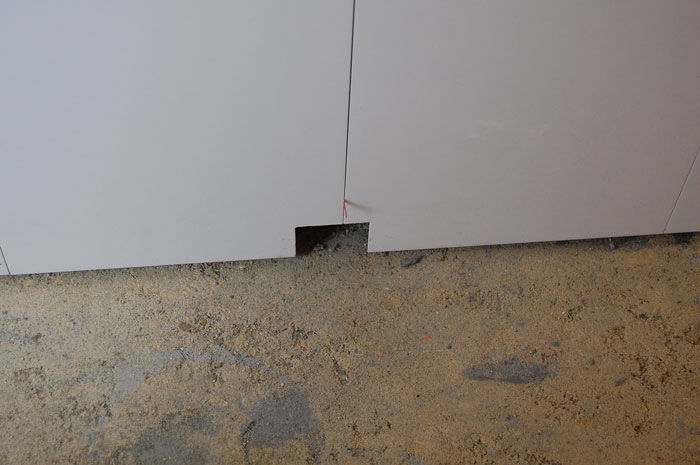
Outlet hole in toilet

Relocate existing bathroom door to create kitchen space
Close up bathroom existing door and create new door at dining room wall. The closed-up bathroom door will create more space in the kitchen for cabinets.

Polish granite floor after tiling
Ask tiler to polish granite floor after tiling, especially to smoothen edges between adjoining granite tiles. This is particularly important if the granite tiles are not perfectly laid as any slight imperfection between two adjoining granite floor tiles can be felt underfoot.

Electrical works
Do electrical wiring and painting immediately after wet works. Without electrical wiring, lighting is not available when natural light condition becomes dim.

Obviously the electrical wiring must be completed before you install the air-con.

Windows
Do windows after hacking and before wall tiling.

If you wish to install ventilation fans in toilets and bathrooms, it is essential you contract for window works early in your renovation to allow time for contractor to get HDB approval.

Plastering works
Get walls screeded, plastered and smoothened. Do same for ceiling if you don't install false ceiling. Will probably screed smooth and plaster even if I don't install false ceiling. Might as well do it once-and-for-all, in case I decide to install false ceiling in future.

Plumbing and gas works
Ensure plumbing is well-coordinated and do that after hacking, before wall tiling. This is because tilers have better skills in cutting tiles to fit the piping. Plumbers simply don't drill or cut tiles as well as the tilers.

Likewise, get the gas connected early before doing the kitchen cabinets.

Get the sanitary dealer to create and open "holes" required for soap dispensers, etc before delivery of the kitchen sink or wash basin. Otherwise you will be in a no-win situation if your plumber refuses to take responsibility if he damages the sink when drilling the hole in the sink for the soap dispenser.

Door framing and doors
Do door frames after hacking and before tiling, and coordinate with the tilers. Don't forget to do main entrance door frame as well before floor is tiled.

Painting
Do painting after electrical wiring and wall smoothening and plastering have been

completed, obviously. In our case we decided to paint before running and laying the trunking for the aircon and electrical wiring, as we didn't want to paint the white plastic trunking for added contrast to the pastel magnolia-painted walls. That however entailed additional "touch-up" paint work after the aircon and electrical wiring installations.

Kitchen cabinet
Probably get one of the solid wood worktop from Ikea.

Get carpenter to provide wood dividers along the lines of Blum's Orgaline organizer or Ikea's Ratiionell dividers and inserts for drawers. Reason? Our drawers were made to fit our kitchen layout, with widths of 73cm and 62cm, not standard widths for the Orgaline or Rationell series. Wood dividers for drawers are relatively easy and straight-forward to D-I-Y.

Probably get the carpenter to fix translucent plastic panels for the wall cabinet pelmet in place of white laminate plywood. Then fix energy-saving light tubes or bulbs inside the pelmet to illuminate the kitchen at night when the main kitchen light is switched off. Not only will the illuminated panels produce a soothing and pretty lighting effect, there is also no need to turn on and off the main kitchen light whenever any family member enters the kitchen for a short while. Which is what we do all the time!

Ensure the ID works out the cabinet design with the carpenter before the cabinets are made. Example: the carpenter was unable to fix removable baskets under our kitchen sink because the ID had assumed the carpenter could simply install the basket runners after making the sink cabinet. By the time the ID realized that was not possible without first removing the sink, it was too late.

We will get the Blum's Aventos bi-fold lift system for the dish drainer instead of the present 60 deg lift-up glass panel. That is to preempt any possibility of the panel getting in the way of taller guests who use the kitchen sink, the reason why we originally specified roller door for the disk drainer unit. As it is, the glass panel clears our 175cm height with inches to spare when opening or closing, but will hit taller guests.

Oh, also to research on another laminate brand to use for the cabinets. Definitely we will not use EPL Laminate (TAK) again, as we think it is prone to abrasions (read our earlier post).

We will also take more time to determine drawer depths for our kitchen, to ensure optimal usage of limited drawer space. Most IDs will speak in terms of outside dimensions, which is appropriate for design and layout but not useful when talking about functionality. An 7-inch drawer height for instance gives an internal depth of only 3.75-inches, after allowing for framework and internal braces.

Our glass splash back was installed after the cabinets had been installed. That would be fine if there were

no tall cabinets to contend with. With a tall oven cabinet at one end of the worktop, the installers had to take care to ensure the side laminate wall of the tall cabinet was not scratched by the glass panel during installation.

That was a difficult task. The glass panel was made to measure, and had to fit exactly onto the back wall. So there was zero leeway in moving the glass panel during installation, and the installers did not bring any plastic sheet to protect the side cabinet.

Somehow the installers managed to put up the glass panel, leaving only a 5" vertical scuff mark on the laminate, but no scratch.

We accepted the scuff mark, but wondered if the glass panel could have been installed before putting up the tall oven cabinet? That was a possibility, but would have entailed more planning and more work. Putting up a plastic protective sheet on the side laminate would be a simpler and better way to prevent scratches or scuff marks on the laminate, and we would do it that way in future.

Finally, the all-important question - would I change the ID? Well, that is the subject of another post!!


Related Posts
1 Mistakes Made
2 Worktop-to-Hood Distance
3 Dish Drainer Cabinet
4 What Will We Do Differently?
5 Kitchen - Mistakes
6 Plumbing - Sinks

Kitchen Ideas - Worktop Protector

Imagine our dismay when we learnt that most modern worktops are neither heat nor stain-proof. Instead the manufacturers used terms like "heat-resistant" and "stain-resistant" to sell their products. To us that is as good as saying the worktops are affected by heat and attract stains.

In future we would likely consider solid wood worktops. Properly sealed and finished, solid wood worktops are probably the most heat-proof and stain-proof worktops we know, and hence easy to maintain.

But for the time being, what can we do to ensure our new acrylic worktop doesn't show stains or heat rings after hot pots have been placed on it?

We don't like those metal trivets with legs sold at hardware stores. They rust and are ugly, and you need several sizes to place your pots and pans. Neither do we like round or rectangular woven rattan or bamboo pads. Usually they are somewhere else when we need them! And lest we forget, be mindful the pads stain the worktop when wet as the pads are usually dyed and brightly colored.

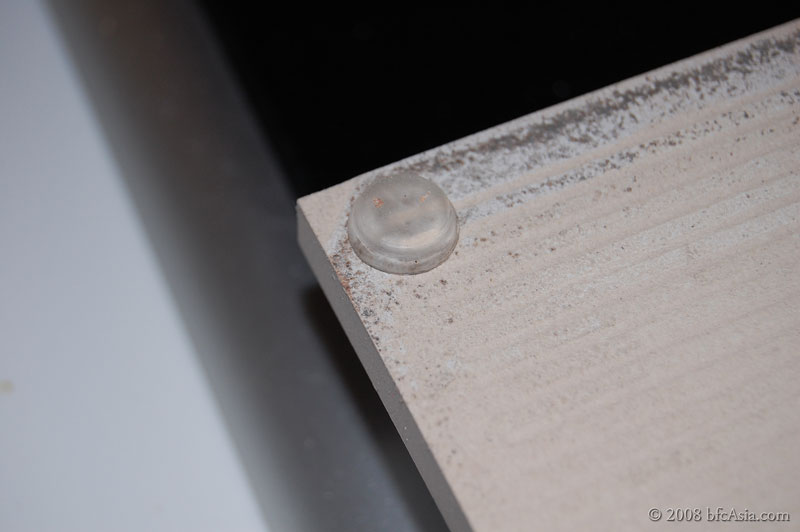
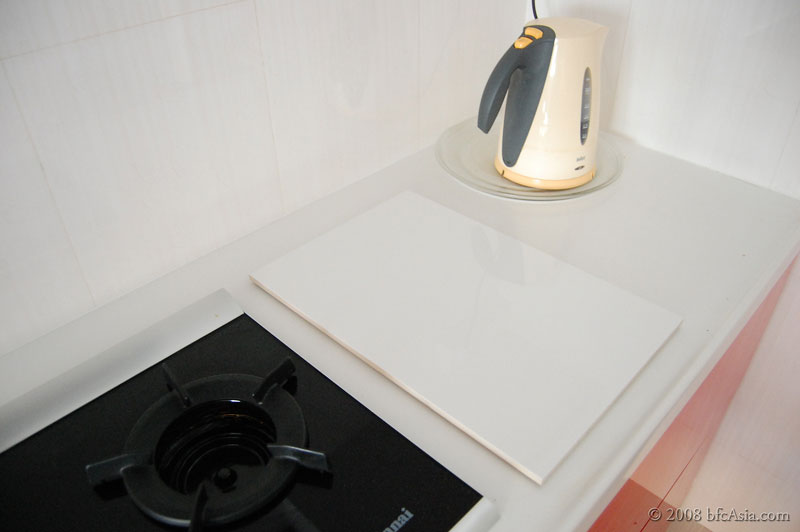
So we got our tiler to smoothen the edges of a left-over 45cm x 30cm white wall tile, attach plastic pads onto the four underside corners, and viola, we've got our worktop protector !

Stick rubber or plastic disks to each underside corner of the tile


Worktop protector made from left-over wall tile


If your renovation has already been completed and the tiler is no longer around, simply use a whetstone (aka knife sharpening stone) to smoothen the sharp edges of the tile. We learnt that from our glass-cutter. He had used a whetstone to smoothen the sharp edges of glass panels he had cut. Very effective!

Kitchen Ideas - Waste Bin

We always wonder how other working couples organize their kitchens, particularly with regard to the "little" things. Little things such as the waste bin, the wiping rag, chopping board, dish detergent, scouring pads, etc. Because those items determine whether your kitchen is cluttered and disorganized, or neat and functional.

Waste Bin

For instance, what do you do with your kitchen waste? Do you use a waste bin and clear it only at the end of the day? Where do you place the waste bin -- inside a cabinet, or simply at a corner of the kitchen floor?

In our old kitchen we had one of those plastic bins that opened by stepping on a pedal. At first we placed the

bin on the floor near the kitchen sink, but soon found it unwieldy to open the bin using the pedal. Subsequently, after we stopped using the bin pedal, and to keep the kitchen tidy, we placed the waste bin inside the sink cabinet.

Not very practical. To throw kitchen waste, we had to open and shut two sets of "doors" - the sink cabinet door and the lid for the bin.

Finally we put away the plastic bin and simply use a waste basket lined with a plastic bag. That was placed on the floor near the sink. Untidy, yes, and a sore sight for the eyes. But it was practical.

For our new kitchen we decided to look at solutions available in the market, such as those offered by Ikea and Poh Joo.

Ikea, Blum and Hettich all provide purpose-built bins for kitchen waste that are placed inside deep drawers under the worktop. The idea is neat and quite presentable, but not practical in our climate.

In our humid and hot climate, we think kitchen waste kept in bins inside deep drawers will go bad very quickly, producing an offensive odor that is difficult to remove inside deep drawers.

Here in Singapore our waste bins are cleared daily by environmental trucks, but in Australia the local council truck clears the rubbish bin once a week because the cool weather permits that.

We also saw a built-in waste bin for the worktop as presented by Poh Joo:

Waste bin with lid built into worktop, S$150 from Poh Joo

Open bin with removable ring removed

Removable ring holds plastic bag to the rim


Poh Joo's waste bin came complete with an outlet plug at the bin bottom that connects to a outlet pipe below the worktop. That allows the bin to be washed easily when the waste has been cleared.
OUR SOLUTION?
None of the commercial solutions appealed to us.


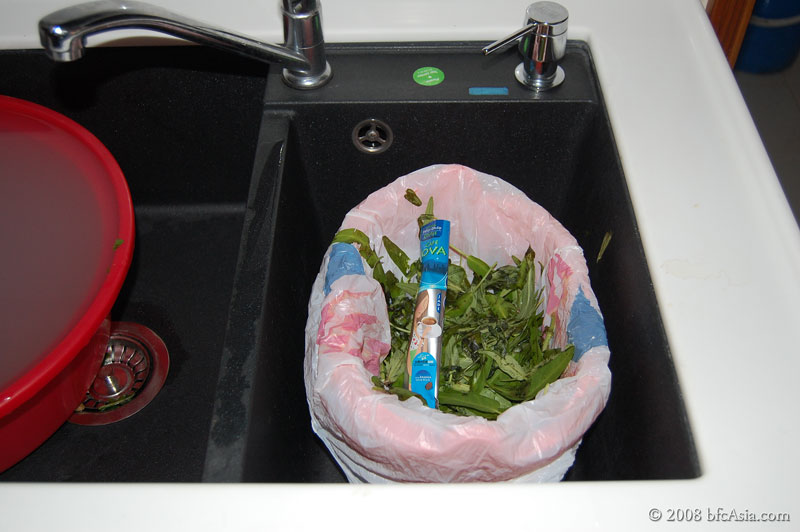
Our idea is simply to use the second bowl of a two-bowl sink as the receptacle for our kitchen waste. Our waste bin is a plastic container with a plastic bag in it, placed in the smaller bowl of the sink, like so:
Waste from food preparation placed into plastic bag

Plastic container cleared after food preparation

Placing the waste bin at the sink near to the Food Prep Zone is logical, because that's where the waste originates.

If desired, we could put the waste bin on the worktop as we prepare the food. When food preparation is completed, simply throw the plastic bag with its waste content into the rubbish chute, wash the plastic container under the tap, and we are done!

Kitchen Zones

Related Posts
1 Kitchen Design
2 Kitchen Zones
3 Perspective Drawing
4 Kitchen Color Scheme
5 Kitchen Drawer System
5 Hettich Drawer Slides & Runners

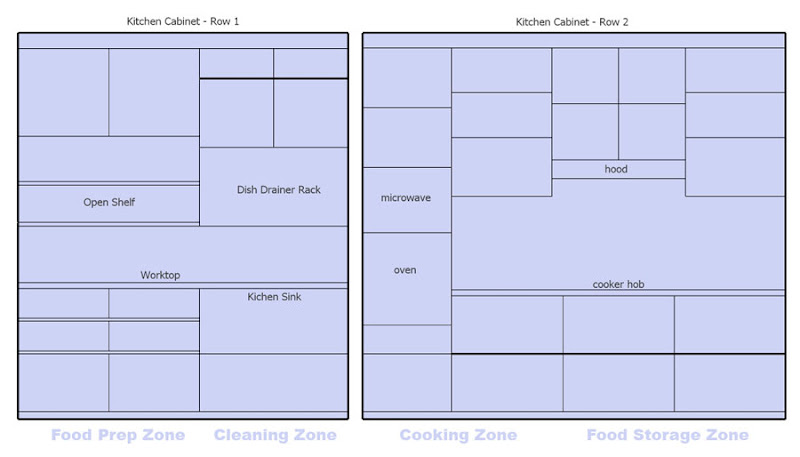
A reader asked why we did not position the cooker hob on the worktop next to the oven, consistent with the idea of a cooking zone where similar tasks are grouped in one location as indicated below:

Hettich's Five Kitchen Zones for:
- Food storage
- Food preparation
- Pots & pans
- Cleaning agents a& waste
- China & cutlery

Blum's Five Kitchen Zones for:
- Consumables storage
- Non-consumables storage
- Cleaning
- Preparation
- Cooking

We loved the ideas presented by Blum and Hettich. We however think it is ok to tweak the ideas a bit to suit our kitchen layout and needs.

Our kitchen zones

Thus we have worktop space on the left and right side of the cooker hob. That way we could place the condiment rack on the right side of the hob and cooked dishes on the left.

Owing to space constraints and kitchen layout, we had to place the large GE Profile refrigerator next to the oven cabinet. Our Food Storage Zone is therefore not contiguous but interspersed with units in the Cooking Zone.

When space and layout constrains you, do what suits you, no need to follow the rules religiously -- as long as the placement is logical and does not veer too far off from the ideal.

Cooking Zone
We don't strictly demarcate an area for the Cooking or Storage Zones, but realized both could overlap without losing their purpose or function.

The Cooking Zone comprises the tall cabinet with the microwave and oven contained therein, and stretches all the way to the cooker hob and suction hood. In between we fixed electrical sockets to plug in electric appliances used occasionally e.g. slow cooker.

Cooking Zone

Below the worktop in between the tall cabinet and the cooker hob are the deep drawers for storing non-consumables e.g. aluminum foil, cling wrap, tongs, trays, extra plates, glasses and cutlery for guests, and so on.

Obviously, items we need for cooking, such as corn or olive oil, condiments such as soy sauce, vinegar, maggi seasoning, etc and spices such as pepper and chilli oil,

etc are placed in this zone. We made a rack to hold these condiments and place the rack on the lower shelf of the wall cabinet next to the suction hood.

Originally we had planned to keep the condiment rack in the deep drawer under the hob. But found the drawer was not deep enough to accommodate tall bottles such as those of soy sauce, vinegar or shiao xing wine. We could have used smaller bottles, but didn't like the idea of always running out of ingredients when we needed them.

Consumables & Non-Consumables Zones
The non-consumables are basically stored in deep drawers and on wall cabinet shelves in the Cooking zone. Aluminum foil, cling wrap, tongs, ladles, extra plates and cutlery for guests, etc (non-consumables) are stored there.

For consumables storage, we placed dried goods and canned foods in the deep drawers to the right of the hob.

Food Preparation Zone
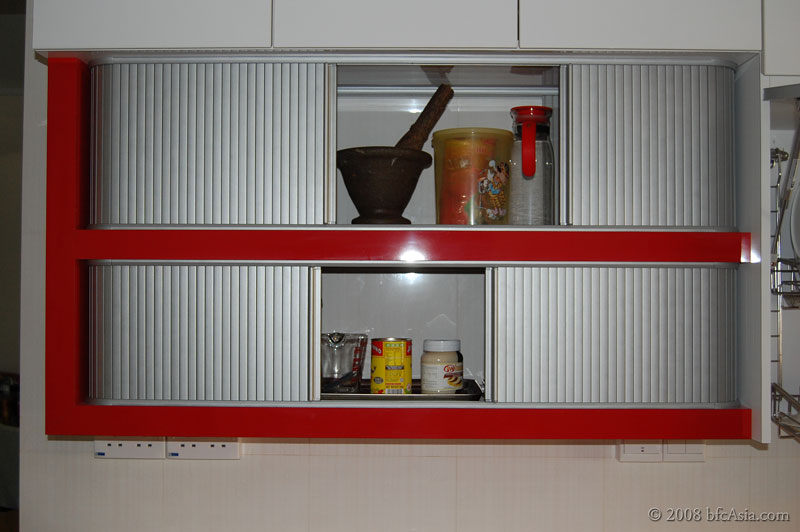
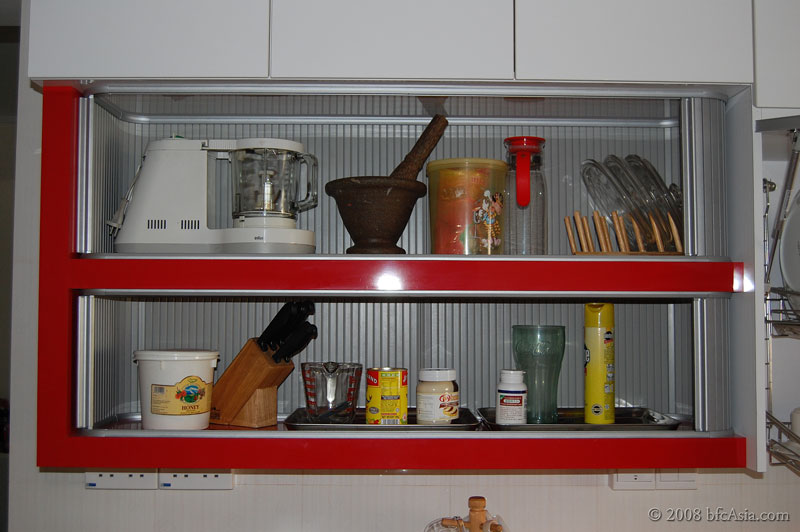
Our Food Preparation Zone consists of the Roller Shelf Unit, the worktop, and several drawers in the base cabinet. The Roller Shelf Unit provides easy access to frequently used items such as sugar, coffee & tea bags, creamer, knife block, etc that are placed on the shelves.

Food Prep Zone

Food preparation entails washing meat, fish and veggies, cutting them on the chopping board, washing utensils and knives used in the food preparation, and finally removing waste organic products from the worktop after the ingredients have been prepared.

All of these activities suggest the Food Preparation Zone must be located next to the kitchen sink.

Roller Shelf Unit


Our breakfast-drinks-snack counter is sited in the Food Preparation Zone.

Throughout the day and (evening too) we make a lot of coffee, tea or Milo and it is convenient to prepare such snacks and drinks next to the kitchen sink. The Roller Shelf Unit gives us quick and open access to items we need frequently.

And we place the toaster, waffle maker, blender, mortar & pestle, juicer, etc on the open shelves for quick and easy access.

Cleaning Zone
For instance, we think the kitchen sink ( aka "the Cleaning Zone" ) is the most important part of the entire kitchen, and plan our kitchen around the sink. That means plates, mugs, pots, pans, kwalis, and other cookware are stored near the sink.

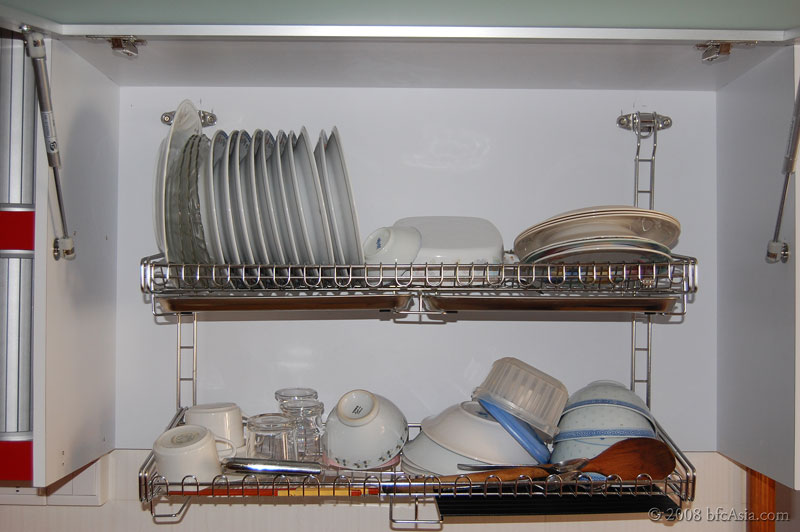
Dish Drainer Unit


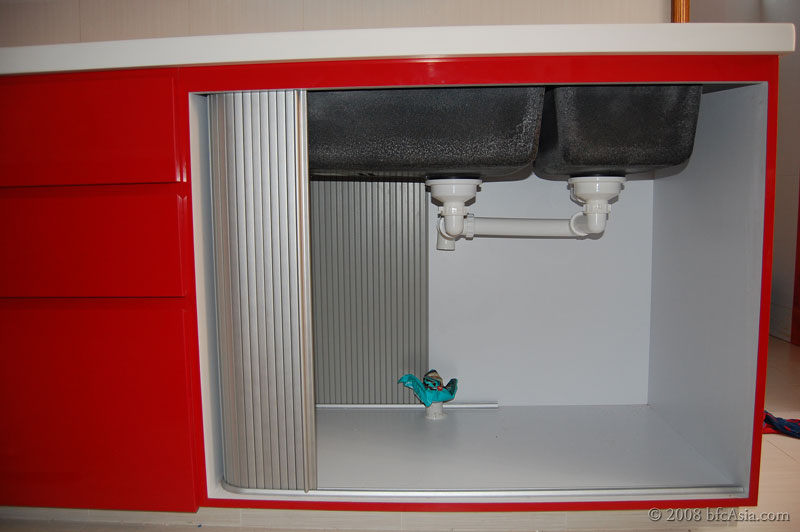
The dish rack above the sink serves both as a drainer and storage for plates, cups, and small flatware. Larger utensils such as kwalis, pots and pans are placed on the rack beneath the sink to dry and store after wash-up.

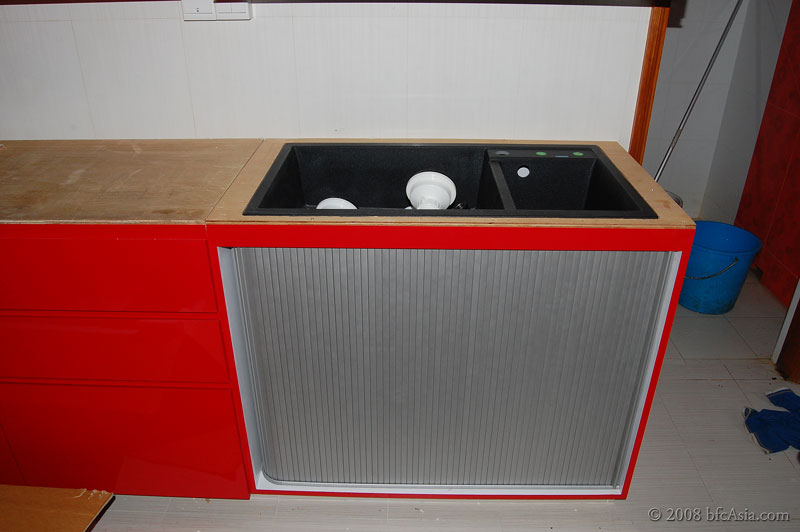
Kitchen Sink with yet-to-install drying rack beneath


Other Storage Zone
Finally, items such as the stainless steel steam-boat and stove, are stored on the upper shelves of the wall cabinets. Such items would require a ladder to take out and put back, hence the upper shelves are ideal for items used infrequently.

Obviously, the defined zones in our kitchen are not sacrosanct. As we use the kitchen in the ensuing months, we will tweak and refine the zones to meet our evolving storage needs.

One Last Word
In our old kitchen we had a TEFAL Oil Fryer, Panasonic Fruit Juicer, Spring kwali and cover, Zebra stock pots, several oil pots, etc -- all of which were not used, two steam boats with accompanying stoves, Tiger Teppanyaki pans, and more china ware, glasses, mugs than we would ever get to use, even when entertaining guests!

For our new kitchen we therefore need to consciously avoid buying kitchen items we do not need immediately. The catchword is immediate. Many times we bought items we thought we would need. Perhaps not immediately but surely at some time in the future? Consequently, over time our kitchen became cluttered with items we have bought but did not use.


Therefore we will assiduously avoid and resist impulse buying of kitchen items such as new pots and pans, appliances, or chinaware that caught our fancy.

That will be the surest way to ensure our new kitchen remains functional and relevant -- not simply a storage place for items we may need in the future.

Related Posts
1 Kitchen Design
2 Kitchen Zones
3 Perspective Drawing
4 Kitchen Color Scheme
5 Kitchen Drawer System
5 Hettich Drawer Slides & Runners

Kitchen - Mistakes

Related Posts
1 Mistakes Made
2 Worktop-to-Hood Distance
3 Dish Drainer Cabinet
4 What Will We Do Differently?
5 Kitchen - Mistakes
6 Plumbing - Sinks

After the cabinets and drawers were completed, we tested the drawer movement for a few days. We were particularly keen to test the load-bearing weight of the deep drawers, especially as drawers provide the main storage for the kitchen. Opening and closing countless times daily, the drawers have to be the workhorse of the kitchen.

Would the drawers stand up to daily punishing usage when fully loaded?

Would we encounter an issue opening and closing fully-laden drawers? Could they take the punishing weight day-in, day-out? After all, with each deep drawer measuring 29-inches wide and 14-inches high and extending fully, they are certainly huge. Fully laden, we felt it would not be easy to open and close the drawer.

Testing the Drawers
We loaded one carton of homogeneous tiles weighing 21 kg into the drawer, and tested the laden drawer. The drawer opened and closed beautifully. No hitches, nothing caught, no stickiness. Movements were quick and smooth.

Drawer loaded with 21-kg weight

We then added another carton of tiles to the one in the drawer, doubling the weight. Then we tested the drawer again. Wow, although the drawer was heavy, movement was still smooth, although not quite as quick as earlier. But the movement was smooth, and the soft-closing mechanism still worked, pulling the drawer shut towards the end.

Less-than-specified load rating for drawer runner slide
Mention must be made however, that we had specified 50kg load bearing for the Hettich runners when we first discussed the cabinet design with the ID. What was provided however was the Quadro model. No one had realized the Quadro was rated for a maximum load of only 30kg. We found that out later when we googled for the product info on the Quadro. Blame the ID mistake on ignorance in purchasing, or unfamiliarity with the various models available. Whatever the case, the redeeming feature of the Quadro was its hidden mounting feature. When the drawer opened, the Hettich runner was not visible as it was mounted on the drawer underside, hidden from view.


It is unlikely our huge drawer fully loaded with plates, bowls, and cutlery will weigh as much as 30 kg. So we didn't mind having the Quadro model as the drawer runner slide for the drawer system. Time will tell whether or not we made the right decision.

Missing drawer runner slide catch
We next tested each drawer for smooth operation and soft-closing. The drawers were opened and shut several times. All drawers opened and closed effortlessly and smoothly, with a soft-closing feature kicking in towards the end, "pulling" in the drawer completely into the base cabinet.

All except two, that is. Two drawers were found to "stick" occasionally.

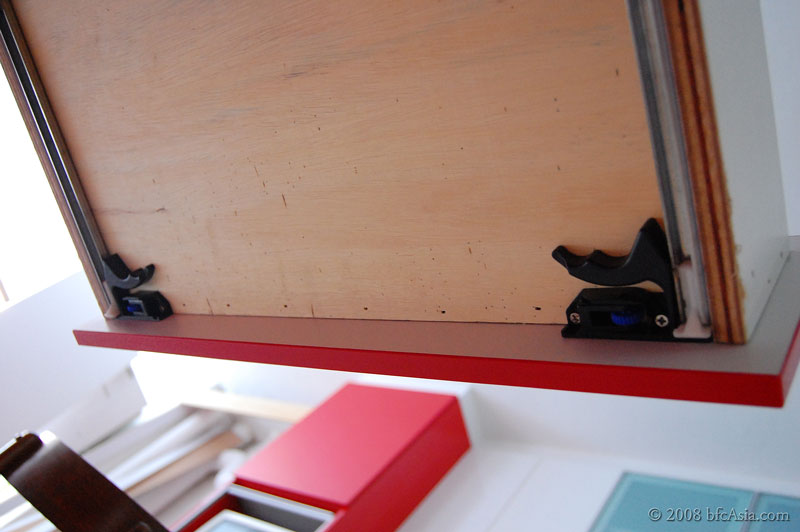
Further investigations revealed that the two drawers had only one drawer runner slide catch or clip instead of two. One metal clip supporting the drawer runner slide was missing on the underside of the two drawers. Hence the drawer occasionally lurched when closing or opening.

Only one Hettich drawer runner slide catch was attached


Missing drawer slide catch installed


After the carpenter installed the missing drawer clips, the drawers opened and closed as smoothly and effortlessly as the other drawers.

Adjusting Shelf Height

A second mistake was in the depth of the drawers in the row directly beneath the cooker hob worktop.

After the drawers in the base cabinets were completed, we found we could not place bottles of condiment like vinegar or soy sauce in them. The bottles were taller than the inside of the drawers!

Apparently aesthetics had taken an upper hand. It was prettier to design two equal rows of drawers of the same height on the hob base cabinet. The alternative would be an upper row of deeper drawers to accommodate tall bottles and a lower row of shallower drawers.

Not a pretty arrangement, we agreed. This was one of those tradeoffs we accepted, where aesthetics won over functionality.

Fortunately it was not one of those do-or-die mistakes.

We could simply adjust the shelf higher in the wall cabinets to take the tall bottles.

Original shelf position


Instead of placing condiments and sauces like vinegar, soy sauce, peanut oil, shiao-xing wine, etc in the deep drawer beneath the cooker hob, we would place them in a tray-like rack and place the the rack on the lower shelf of the wall cabinet.

Shelf moved higher


We would only need to take the condiment rack down from the wall cabinet and place it conveniently on the worktop when we cook.

Doing this makes it easier and cleaner to access soy sauces, spices, shiao-xing wine, etc that we use for cooking. It also makes for a less cluttered worktop when the condiment rack is put away after cooking.

EDL laminate for kitchen cabinets
We first noticed a side of the oven cabinet had suffered abrasions and the plywood showed through the abrasion a day after the electrician had completed their work in the kitchen. Well, there was nothing we could do to rectify the abrasion, except maybe to apply red paint of a similar shade to the laminate to hide the exposed wood.

Side laminate of oven cabinet marred by abrasions

A few days later, the carpenter understudy was none too careful and lightly brushed the plastic padded heal of the aluminum ladder against the side of the sink cabinet as he moved the ladder into the bathroom. It was merely a light brush, because I was helping him to move the ladder.


On closer examination of the laminate after the contact, I was surprised to see the laminate was "bruised" by the plastic-padded heel. There were abrasion marks and the surface had some red paint rubbed off. I was dismayed. Other laminates I had previously encountered would not have shown abrasions from the ladder contact. And I had expected the EDL laminate to take daily "knocks" without showing any the worse for them.

Light brush by ladder plastic heel cause abrasions to laminate surface

So why does the locally produced EDL laminate possess such poor abrasion resistance? Surely the manufacturer has a responsibility to ensure its laminate could withstand normal knocks and abrasions that arose in daily use? The carpenter commented the EDL laminate coating appeared very thin to him. Shouldn't EDL have used a thicker coating for the laminate?

If the EDL laminate is made with such a thin coating on the surface layer, the laminate is obviously unable to withstand the rigors of daily use in a kitchen cabinet. It is unsuitable to use for kitchen cabinets.

Readers should therefore always test a laminate, whatever the brand may be, for abrasion resistance before they adopt it for their kitchen cabinets. If possible, get a written guarantee and check the top surface layer has coatings within tested specified thicknesses. If such minimum standards are not applicable locally, then use comparables from other countries that have adopted minimum standards for laminate thicknesses.

As for us, we have to live with the issue and take extra precaution to avoid contact with any hard object on the laminate surface. We hope EDL will come out with a better product, for their latest glossy range of laminates looks really nice. However, until that happens, we will stop recommending EDL laminate to readers for their cabinets.

To be continued...

- Adjusting the basin level

- Fixing the soap dispenser

- Making the shelving beneath the sink


Related Posts
1 Mistakes Made
2 Worktop-to-Hood Distance
3 Dish Drainer Cabinet
4 What Will We Do Differently?
5 Kitchen - Mistakes
6 Plumbing - Sinks
 

Copyright © 2008-2011 bfcAsia - All photos and contents are copyrighted material of shunFoto.com • All Rights Reserved