Showing posts with label worktop. Show all posts

Workmanship: Worktop & Kitchen Sink

Related Posts
1 Kitchen: Cooking & Food Storage Zone
2 Kitchen: Microwave Oven Cabinet
3 Kitchen: The Sink Unit
4 Kitchen: Food Preparation & Cleaning Zone
5 Kitchen: Worktop & Kitchen Sink
6 Kitchen: Splashback

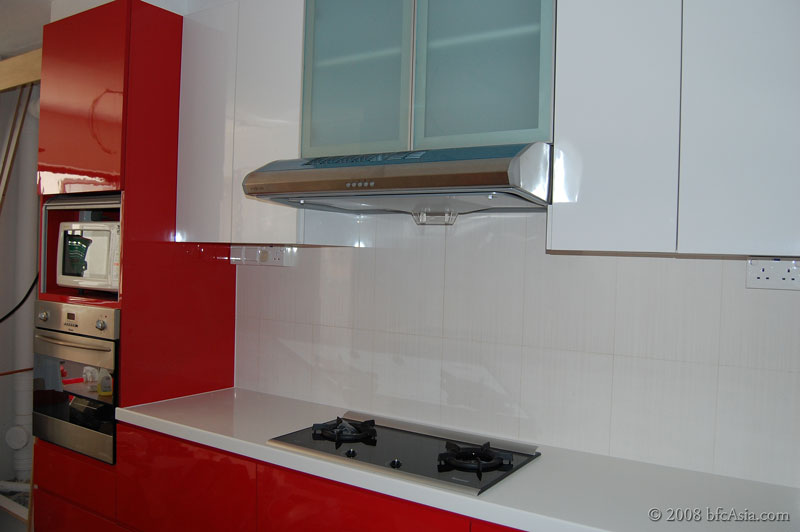
The guys from Asuka delivered two completed acrylic worktop pieces on Thursday 24-Apr-08, one for the hob area, the other for the sink area. Only the hob worktop piece was installed. As this worktop will have its own glass backsplash to be fitted later on, the hob worktop piece was made without a backsplash.

Hob worktop without backsplash

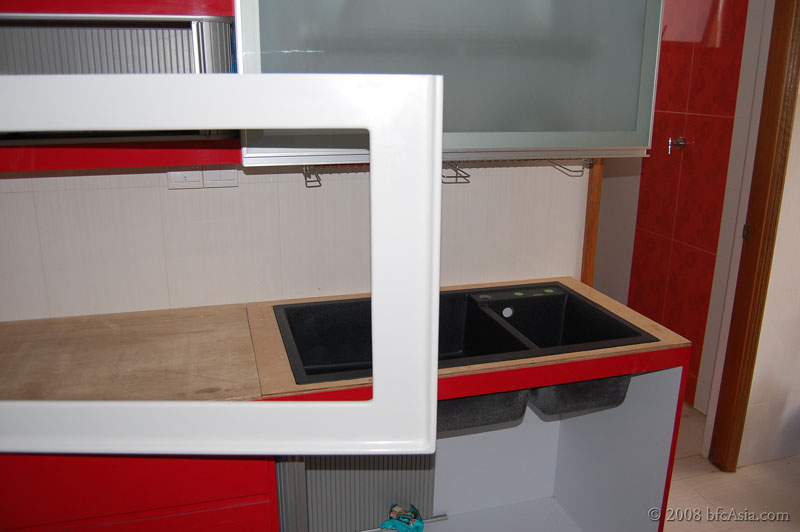
The other piece also had no backsplash. So it had to go back to the workshop to add the 5-cm (2-inches) backsplash. The sink worktop will use the white wall tiles (instead of glass panel) as a backdrop, to add contrast to the opposite side of the galley kitchen. Hence the acrylic top needed a backsplash.

Sink worktop piece with cut-out

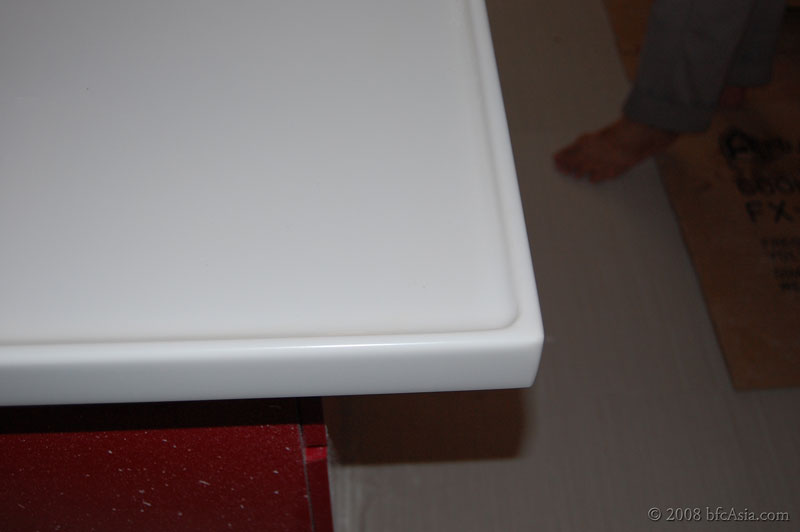
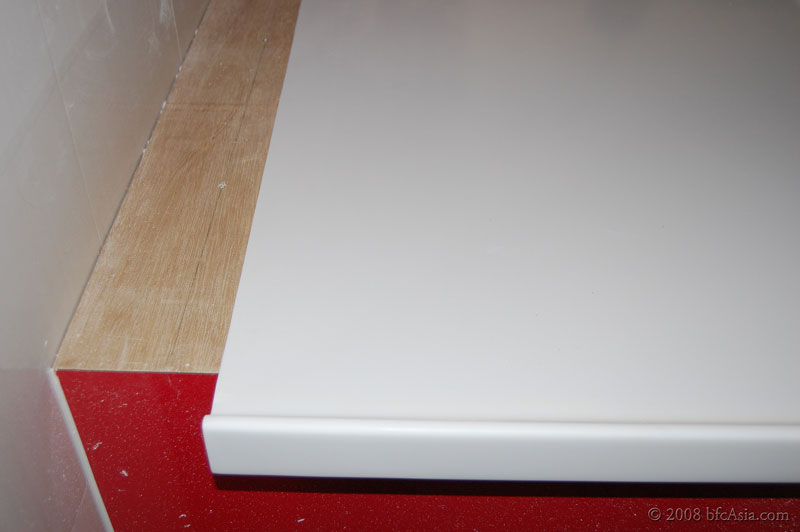
Spill-proof edging design

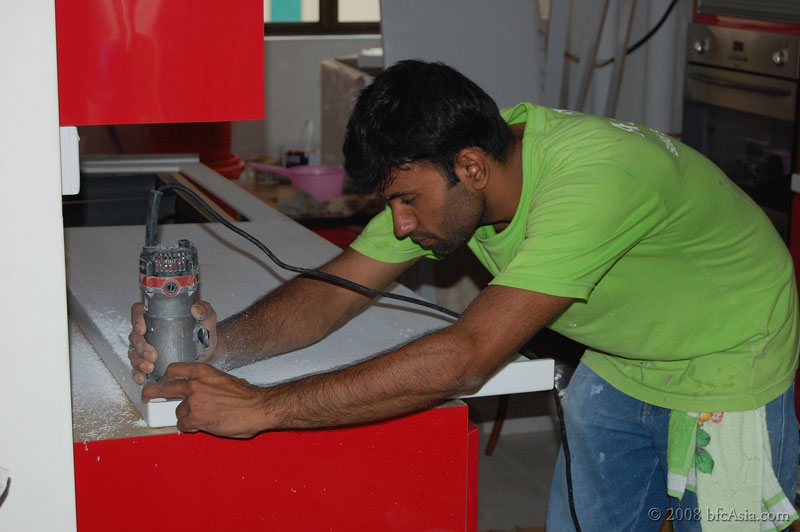
Working the surface

Worktop had to return to workshop because backsplash was missing

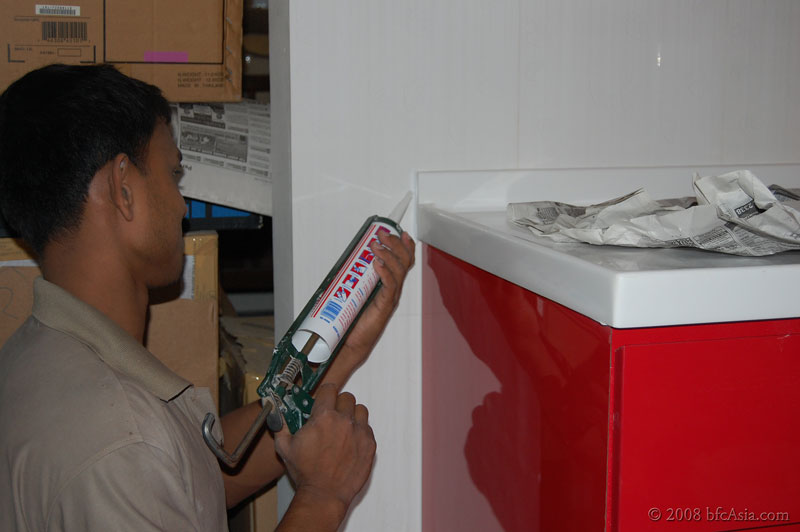
Sealing worktop edges, now with 2-inch backsplash

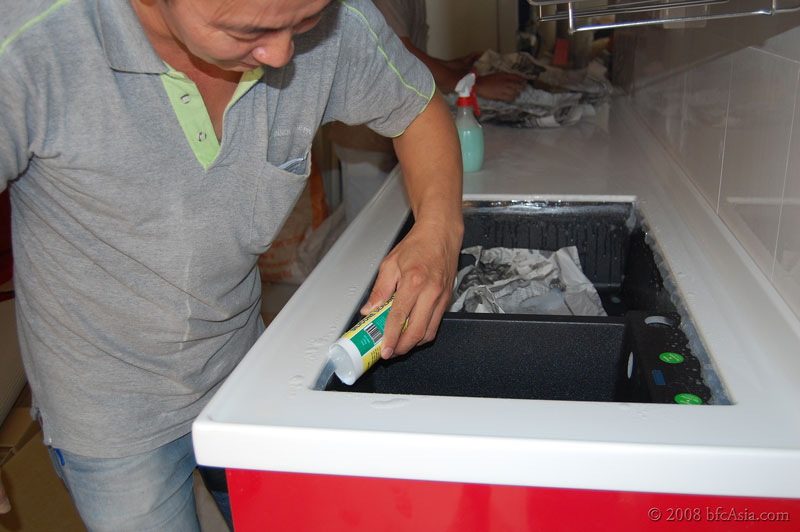
Sealing the rim with silicone

Under-mounted sink before finishing touches

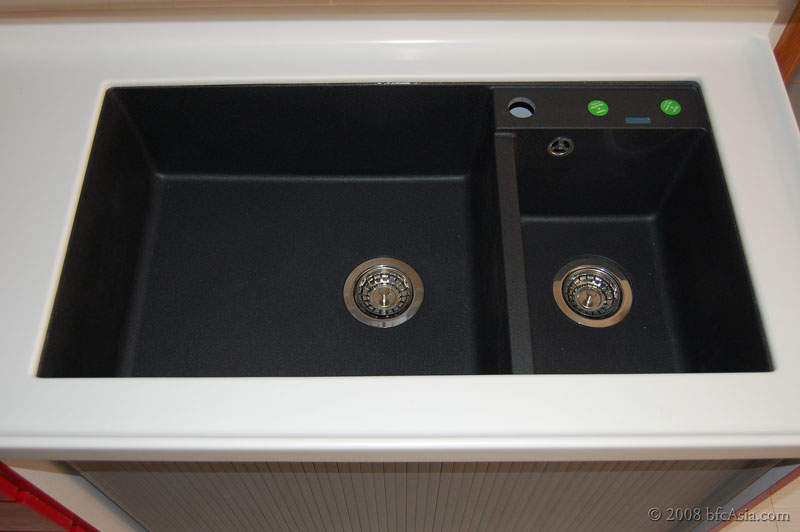
Completed worktop with under-mounted sink

NOTE that the acrylic worktop piece is simply laid onto the plywood base. No glue was used as the acrylic piece was made-to-fit the plywood base. The worker used silicone to seal the edges and the sink rim.

That means if we have to replace the sink or worktop in future, it would be a relatively easy and simple job. Just use a knife to slice through the silicone seam and lift up the acrylic worktop piece. The sink can similarly be lifted up and replaced once the silicone seam has been sliced through.

TEST: I tried to shake and move the acrylic worktop. It did not budge and the feel was solid. The supervisor smiled and assured me I had no worries because the acrylic worktop was (1) heavy and (2) the fitting was exact, owing to the templating production process.

These two factors result in a stable, solid worktop, despite no glue being applied to install the worktop.

Related Posts: Kitchen Works
1 Kitchen: Cooking & Food Storage Zone
2 Kitchen: Microwave Oven Cabinet
3 Kitchen: The Sink Unit
4 Kitchen: Food Preparation & Cleaning Zone
5 Kitchen: Worktop & Kitchen Sink
6 Kitchen: Splashback

For Your Further Reference

Related Posts
1 How to Choose: Kitchen Worktop
2 My Acrylic Worktop
3 Verdict: My Asuka Acrylic Worktop
4 DIY: Worktop Protector
5 Further Reference
6 Silestone FAQ
7 Maintenance: Granite Worktop

Interesting Read
There is no lack of information on worktops on the Net. You need however to wade through a lot of junk articles before you come across some useful info.

Below are two examples of forum comments posted by industry experts on the materials of worktops that I find useful and relevant. Hit the source link for the full reference.

Source: www.chowhound.com

2. MakingSense May 16, 2007 10:12PM

Interesting thread about choices of countertops. We sell all three types, granite, quartz and solid surface (corian type).

Granite always wins the beauty contest, till one of the polyester colors gets noticed. About half of the visitors at a home and garden show will think it is granite. Good granite can be a good countertop, if you do your homework on the

types available and are careful who you get to fabricate it. Heat however will occasionally crack a granite top, the local big box stores have placards warning of this, and it has been our experience as well, so we warn customers not to put hot pots on their top. Usually the crack occurs as the top cools. Some have posted on the heat sink abilities of stone, which causes it to expand locally while the rest of the top isn't moving. This sets up stresses that will cause a crack on occasion, especially in highly fissured materials.

Some mentioned the resined products, which have acrylic resins, the same as in solid surface, spread on one or both sides. Usually this is done to bring an unsuitable stone to market, because of cheapness or beauty of that particular vein. One thing to watch out for is an unscrupulous fabricator staining the edge of the resined tops in an attempt to get it to match the rest of the stone. It does wear off with time.

Make sure your granite is rodded both front and back of all cutouts. This isn't to prevent cracking, it won't, it is to hold the pieces together so the installer can patch it.

One in five tops gets broken prior to installation, one of the reasons why no one will warranty granite tops.

Make sure they use sink clips, not just epoxy for the sink mounting. The cross members are even better, but the clips are still installed by the best shops.

Staining, so many stones, so many degrees of tolerance by customers and so many standards of neatness by homeowners and cooks. We recommend that customers save the beautiful granite top for when the kids leave home. Too many pizza boxes get left out with kids in the house, peanut butter, anything with an oil base will mark the tops if it is not quickly wiped up. Most reputable stone sites will tell you this on their care and maintenance pages.

Two of the most notorious warnings about granite are radon and bacteria. Some say the radon is over rated, and it is just about what you would get from watching tv for eight hours, or sitting at a computer screen for the same, but the Chinese govt has classified granite into three grades, A, B, and C. The A grade have a small enough amount to put inside homes, the B's have more radioactivity and can be used in public buildings in moderation. The C grades are bad enough that they must be used only on exteriors of buildings. The Chines govt bans the export of A grade, if I remember correctly, so check the source of your granite carefully. There is a study online on Springer link if anyone is interested.

The bacteria, well that depends on who you ask. The stone industry latched onto a study done a couple of years ago by a stainless steel group that had stone ranked second in cleanability. Once you read the fine print, it actually a study of kill rates of bacteria on surfaces. Stainless and stone had higher kill rates, or worded another way, they had higher numbers of bacteria on them after being inoculated with bacteria, and when sanitized they rinsed off more dead bacteria than other surfaces.

The MIA, a stone group, redid the study in such a way that granite "won" the test, and have been publishing this everywhere. The first study, however left out not only solid surface (corian) but quartz surfaces, the market leaders in tops, and chose other materials that have less than eight percent market share combined. The second study also left out the market leaders of countertops. One should ask why they were left out. Also, do the math after you read the study, it would take 176 gallons of water to rinse off your countertops if you used their method, also they recommend you NOT use their sanitizing method on stone countertops.

Quartz is also not intended for hot pots, our warranty and template sheets all state this clearly, as does the manufacture manuals and warranty sheets. It will also scratch, which are near impossible to remove with out spending a half a day of

extremely high priced labor . That said it performs better with kids in the home than granite. It can be damaged by UV, which is not considered a warranty defect, it is expected to change color somewhat as it ages, but watch for putting things like toasters or cannister sets long term, it will leave light or dark spots depending on color. Also listed on the manufacturer sheets is oil, inks, permant markers and high pH cleaners or things like scotchbite or Comet. It is composed of about 35% solid surface with stone chips embeded.

Solid surface is what I put in my kitchen. we work six days a week in the high end kitchen business with little free time for maintenance. Sinks five or six years ago could crack if exposed to ice and boiling water at the same time, but they fixed that about four years ago and now warranty it not to occur. They can be repaired in place or replaced easily. Same with scratches. In six years of selling tops, we have polished out six scratches in solid surface tops, all but one were prior to the homeowner moving into the home. Granite and quartz, well we do not offer scratch removal as it is impractical at best, solid surface scratch removal is free since it takes so little time.

One of the best things about solid surface is it's ability to stay sanitary. It and quartz are approved by the National Sanitation Foundation for food prep, one reason why you won't see too many granite tops in a fast food store. All materials in solid surface are FDA approved, don't believe that quartz or engineered stone can claim that since quartz chips are not FDA approved.

I belong to a group of countertop fabricators that fab and sell all types of materials. We are in the middle of a study on bacteria and materials that focuses on what is left after cleaning, since in our minds that is the important thing. True bacteria and stainless will allow more bacteria to grow, but that is a negative not a positive. So far, the tests have shown that granite ranks poorly if the sealer is worn, but even with new sealer it retains and allows far more growth of bacteria than solid surface. Even after sanitizing, the results show that solid surface was NSF approved for a reason.

Here is a link that supports this, done by microbiology experts. Note the difference between granite and polypropylene when measured with different strains of bacteria, but the important one was raw chicken juice which the granite soaked up three times more than any other surface. The MUSC variety was cultured from chicken breast meat, and is far less dangerous than the EMB cultured from juice.

https://repositorium.sdum.uminho.pt/b...

Good luck on your choice of tops, if cared for and maintained, you will enjoy any of them. Be sure and seal granite often and sanitize even more often.

Carpentershop May 08

====

jean larosa May 08, 2007 06:31PM

1. re: jean larosa

Jean, sorry for the late reply, but get your sealer from the place that you bought your granite from. You don't want to mix the water based sealers and the solvent based sealers. If in doubt, use acetone to strip the old sealer before you reseal.

The big box stores are all about margin on what they sell, not what is best. Your stone fabricator will have a vested interest in selling you a good sealer.

That said, there is one that has been a favorite with many shops. It is called Miracle 511 sealer / enhancer. Another called STT SB is showing quite a following, but it is new. I like the 511 personally, but the new one might do just as well.

Do your research on your type of granite, go to a good stone site first and ask if they recommend sealer on it. Thing you have to watch for is the double talk that many are good at. Some stone guys think that telling people that granite needs sealing is bad for business, others are more interested in making sure they get no callbacks on stains, so they will recommend the sealant.

You can also overseal which is the cause of many customer complaints on granite, people will write that every time they use their stone tops, they leave a new mark.

What the real problem turns out is that they have put a coating on a harder surface, the softer of the two will get marked up easily.

Darned if you do and darned if you don't, which is why we recomend solid surface for many families. As long as you understand that granite will stain and look at it as a character mark, distressing so to speak (the rest of the world looks at it this way), can live with less than perfection on the surface, you will enjoy your granite top.

One interesting thing happened on our latest round of testing. The sealed products bred bacteria by a huge factor over unsealed granite. So much so that we are repeating the test to look for errors. Another result that was not going to be appreciated was a microban infused quartz product that performed poorly, very poorly although it grew mostly general coliform bacteria, it grew a lot of them. It will be re tested as well. So much can go wrong when you are dealing with microbiology testing, it pays to retest and be conservative.

Related Posts
1 How to Choose: Kitchen Worktop
2 My Acrylic Worktop
3 Verdict: My Asuka Acrylic Worktop
4 DIY: Worktop Protector
5 Further Reference
6 Silestone FAQ
7 Maintenance: Granite Worktop

How to Choose: Kitchen Worktop

Related Posts
1 How to Choose: Kitchen Worktop
2 My Acrylic Worktop
3 Verdict: My Asuka Acrylic Worktop
4 DIY: Worktop Protector
5 Further Reference
6 Silestone FAQ
7 Maintenance: Granite Worktop

Note: This is an update of an older article.

In deciding what kind of worktop I should get for my kitchen, I used the following criteria, in no particular order of importance:

- Resists heat, stains, scratches
- Easy to maintain
- Durable
- Beautiful
- Affordable

A note about "affordable". I am using that term in the subjective sense here -- "affordable" does not equate to "cheap" or "expensive" per se.

Our acrylic worktop is affordable, durable, pretty, easy to maintain
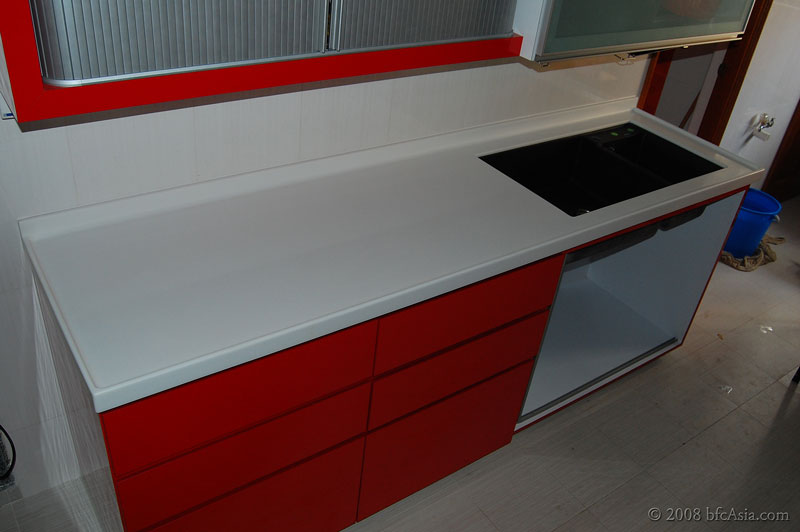
To me, a worktop that costs $4,000 and lasts a lifetime is cheaper than another that costs $1,000 and lasts say, 5 years, all other things being equal.

If the worktop is easy to maintain, looks good, and lasts a long time -- that worktop is affordable to me. I am pretty laid-back and hate to expend time, effort and money to replace a functional worktop when it is serving its purpose well day-in, day-out. So in that sense the $4,000 worktop is affordable to me, the $1,000 worktop is not. Not because of price, but because of my value system.

Thus someone who values the latest trend or latest innovation in worktops will find the $1,000 worktop "more" affordable because he will probably replace his worktop within 5 years. Sure, he too can afford to buy the $4,000 worktop -- but price is not the issue here. The term "value for money" encapsulates the idea.

Granite, Silestone, Slate & Other Stones
Initially I was drawn to granite: it is beautiful, hard-wearing, and long-lasting. Or so I thought.

Not so, said users who have had used granite worktops. Reason? Granite is not a homogeneous stone, there are fissures and areas of high stress in the rock. Some users reported their granite tops developed cracks after about 5-8 years of usage. Therefore hot pots and pans should not be placed directly onto the granite worktop, but on trivets or other protection placed atop the granite surface.

Also, contrary to what I thought -- granite is porous! Simple test: pour water on a granite floor, wait a few minutes and then wipe off the excess water. You will see the granite tile become much darker than another adjoining tile that is dry. That is because water was absorbed by the granite tile when you poured water onto it.

Owing to its porosity, the granite dealer advised me not to use any chemical to clean the granite floor, just plain clean water will do.

Likewise, granite worktops may absorb stains depending on how porous that particular area is. Depending on luck, you may get a top which is impervious and that is fine. In any event, granite used in worktops should be sealed and maintained regularly, with re-sealing once every 5-6 months to maintain the worktop in pristine condition.

Silestone offers the least maintenance, but not everybody like the colors or patterns available, although the premium range looks real beautiful to me. Locally

the range is limited, however. Silestone is very pricey, more expensive than granite for the premium range. Those who don't like it said it looks similar to terrazoo stone while others reported the joints split after some years.

I shall not go into slate, sandstone or other natural stones that are also used for worktops.

Acrylics
Corian, like other acrylic-based worktops, has its share of maintenance issues too. They stain badly. If you don't believe, rub tumeric powder or yellow ginger onto the surface, then try to clean off the stain after 5-10 minutes. Also, some users experienced rings on the top after placing hot pots and pans directly on the surface.

Hence, acrylics' maintenance is no more arduous than natural stones', probably less as no regular re-sealing is required. As for heat and stains, the care needed to maintain the worktop in pristine condition is the same as natural stones. Acrylics however is softer than natural stones and scratches more easily. That same hardness attribute makes it easier to remove scratches too.

When we first installed our Corian worktop 20 years ago we didn't know better, and believed everything the product literature said. Such as "heat-resistant" which we took to mean we could carelessly place hot objects on the worktop. Or "stain-resistant", which meant we didn't have to wipe off curry-paste spills immediately.

One other point: acrylic worktop like Corian may "yellow" with time, particularly if your worktop is a lighter color such as cream or white. My old worktop was a light sand color: it showed its age after 9-10 years. Darker patches also developed with time near the microwave oven, probably as a result of placing hot containers there after taking them out of the microwave.

Acrylic worktop made-to-order and custom-fitted to cabinet base
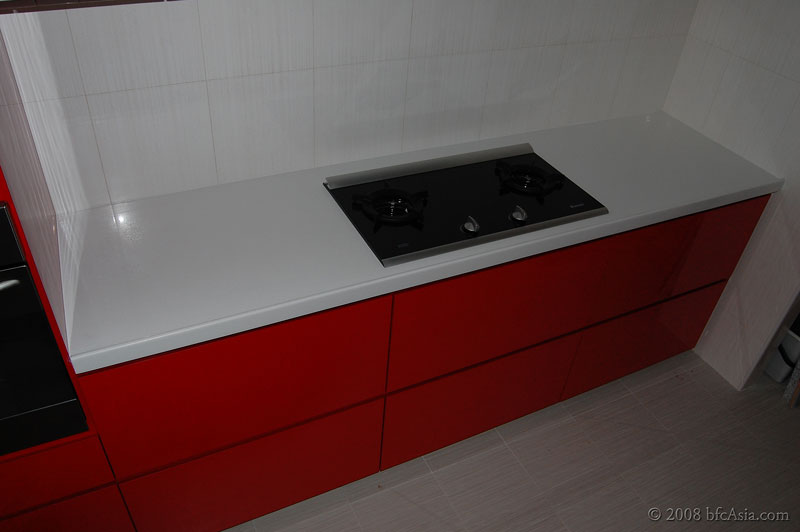
Sinks moulded from one piece Corian or acrylic top? That used to be the rage a

decade ago. Few now go for that, as the sink encounters stains and is difficult to maintain its original clean look, especially after one has poured hot coffee followed by ice cubes into the sink. That comment came from users who have had sinks moulded in Corian or other acrylic polymers in a one-piece worktop.

Others
Solid glass worktop seems to be a recent innovation, similar to Silestone. However, worktop glass needs to be custom-ordered and the kitchen skilfully designed to bring out glass' appeal (read: lighting techniques). Locally, I believe glass worktops are not available yet because special installation skills are required.

Some use cement worktops successfully, some use tiles, Formica, even stainless steel. Others use solid wood worktops such as those from Ikea which are beautiful but seem to have been surpassed in popularity by acrylics and natural stone.

Summing Up
Now, after looking at several different materials for the kitchen workshop and their attributes -- such as solid glass, solid wood, granite, marble, acrylics, silestone, cement, tiles, etc -- I finally decided on a simple acrylic worktop for my new kitchen.

Acrylic worktop is easily lifted up without damage to underlying cabinet base
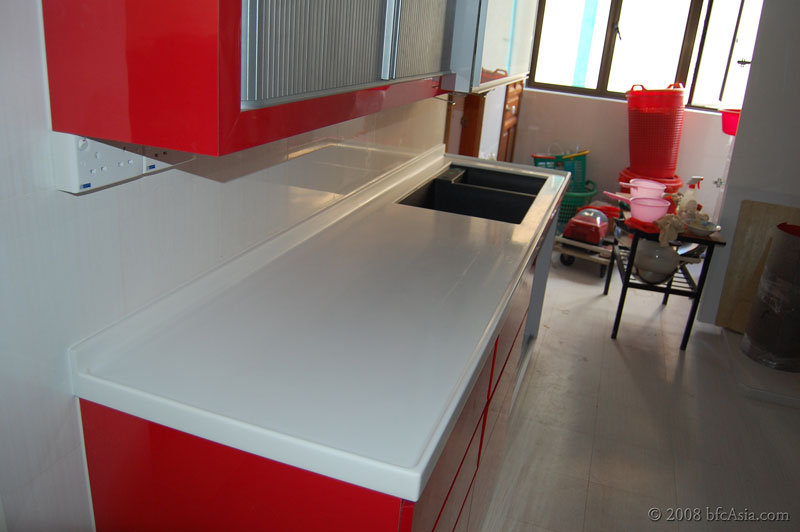
Why so? Well, let me share my findings, which are by no means exhaustive. They may also not be applicable in your case, because of differing values, as mentioned earlier. So no offense intended!

Resistance to stain, heat, scratches - No single worktop material meets all three requirements satisfactorily e.g. acrylics are affected to some degree by heat, stain, and scratches -- despite what the promotional blurbs say.

Even Silestone, which requires least maintenance, needs careful placement of hot pots and pans to avoid thermal stress. The following was extracted from a leading US producer of Silestone under its Care and Maintenance section:

QUOTE:

CAUTION

The following will harm Silestone Quartz: Drano®, Liquid Plumr®, oven cleaners and floor strippers. Do NOT use these or any other harsh chemicals on your Silestone surface.

CAUTION

Do NOT use crock pots or electric skillets while in direct contact with your Silestone surfaces. Always place them on a trivet or cutting board to protect your countertop. (Review your electric appliance manual as a reference.) Silestone is a stone product. As with any natural stone, certain exposure to heat may cause cracks due to thermal shock.

UNQUOTE

Durability, beauty, easy to maintain -- All worktops, no matter what material they are made of, are beautiful and durable, provided care is taken in maintaining them.

That means:

- don't place hot pots and pans directly on the worktop surface
- wipe up stains and liquids on the worktop surface immediately
- clean, dry, and polish the worktop surface at the end of the day
- if sealing is mandated, apply sealer regularly as recommended by the dealer

Given the above, my conclusion is an acrylic-based worktop. It requires no more (in fact, less) maintenance and care than worktops of natural stones or other materials, yet is as beautiful and durable as the others.

And since I cannot find any unique benefit in using Corian over other acrylic worktops, I simply went for a custom-made acrylic worktop produced by Asuka, a local factory.

Judge for yourself whether the worktop looks more or less beautiful than Corian
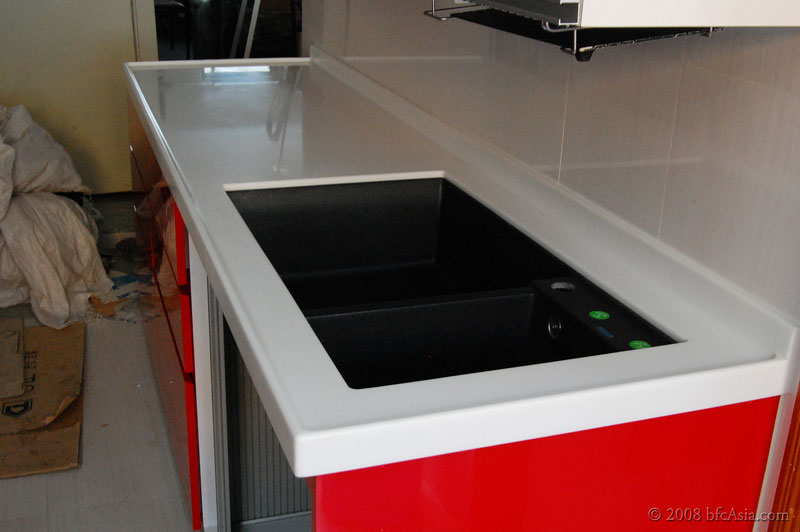
To us the acrylic worktop looks the same as any other acrylic-based worktop such as Corian. Value for money indeed !

ADDENDUM
13-May-08 : After reaching home from shopping at Sheng Siong, we placed the plastic

grocery bags onto the acrylic worktop, prior to putting away the groceries for storage. After storing the groceries, we cleared the plastic bags and found to our surprise that the worktop was stained with the blue dye from one of the printed grocery bags that had lain directly on the worktop.

We tried using soap, and when that failed to remove the stain, we used Lemon Pledge that was recommended by the worktop guys previously. The blue stain came off a bit but did not disappear entirely. Finally we tried thinner, and viola! the stain was removed.

So keep a bottle of thinner that may be purchased from any hardware shop in the kitchen.

Related Posts
1 How to Choose: Kitchen Worktop
2 My Acrylic Worktop
3 Verdict: My Asuka Acrylic Worktop
4 DIY: Worktop Protector
5 Further Reference
6 Silestone FAQ
7 Maintenance: Granite Worktop

Review: Asuka Acrylic Worktop

Review Series
1: Blanco Sink - 3 stars
2: Rinnai Gas Heater - Not Rated
3: Fujioh hood FX-900 - 5 stars
4: Rinnai Tumble Dryer RDT-600CG - 5 stars
5: Rinnai Oven RBO-7MSO - 3 stars
6: Bellari Liquid Dispenser - 1 star
7: Rinnai 2-Burner Hob RB-2CG - 5 stars
8: TOTO Omni Toilet Bowl- 5 stars
9: Asuka Acrylic Worktop - 2 stars
10: Premier laminated floor tiles

Related Posts
1 How to Choose: Kitchen Worktop
2 My Acrylic Worktop
3 Verdict: My Asuka Acrylic Worktop
4 DIY: Worktop Protector
5 Further Reference
6 Silestone FAQ
7 Maintenance: Granite Worktop

A word about the Review
Our Review is different from other reviews that you read on the Net: we're not armchair reviewers. We bought and installed the product for our own use. No one sponsored us to endorse the product. And we only gave our verdict after at least one year's usage. Obviously, we'd tell you sooner if a product didn't work or performed poorly soon after purchase.

We invite you - if you have bought, installed and used the product to tell us your user experience, particularly after using the product for at least a year. Whether positive or negative, please give us your feedback. Oh, don't forget to provide your local forum (Renotalk.com, myHomeTown.com.sg, Sengkang.com, or Punggol.org) user ID and photos of your kitchen so we could verify you're a bonafide user of the product.


Verdict: 2 out of 5 stars - Not Recommended

This post is in response to a reader "Jaz" who sent an email that I somehow overlooked as I was extremely busy and preoccupied recently.

Thanks Jaz for your support of my blog !!  My apologies for this belated post!

FYI, it has been some 2 yrs of worktop usage (or abusage) so I now know my Asuka worktop better.

In a word: don't install anything that your ID or contractor recommends! My Asuka acrylic worktop stains easily -- too easily for a so-called acrylic

worktop that I am not even sure if it is really acrylic that was installed in my kitchen.

I began to suspect something was not right with my worktop when I went to Ikea Alexandra recently and handled and inspected the acrylic worktops displayed there. The tactile sensation was different - the Ikea acrylic worktop somewhat felt different from my acrylic worktop - in a way I was not sure.

Call me pig-headed, nit-picking, or simply prejudiced now with my Asuka worktop, but my acrylic worktop stains too easily to be acrylic. Maybe it was made of a different plastic / resin combination (read: cheaper materials) and the ID chose to install that instead of the real stuff in my kitchen? My previous worktop was also acrylic, but it was quite stain resistant.

But this one - forget to wipe any dripping from a soiled plate placed on the worktop, come back one hour later and you find the drip has stained the worktop! Or place a Fairprice plastic bag full of grocery on the worktop, and when you have taken out the grocery you find the worktop stained with the blue ink from the grocery bag print !!  And the ink stain was a real pain to remove.

I scratched my head... what went wrong?

Then I realized factories can combine resin with any plastic compound under heat and pressure to produce solid surfaces that can be used to fabricate

kitchen worktops, wash basins, etc.  You can see plastic-based wash basins at showrooms produced locally.  Even toilet bowls are also fashioned from plastic resins!

So how do consumers know that the solid surface top supplied for his worktop is really acrylic?  The specifications, the brand or the factory, is not printed anywhere on the material supplied.  Is my Asuka worktop really made of acrylic? Now, make no mistake - I am not suggesting my ID / Contractor  or Asuka was dishonest.. or that my Asuka worktop is not made of acrylic.  All this is simply conjecture on my part.

Verdict: 2 out of 5 stars - Not Recommended

What I know however is that my Asuka acrylic worktop stains too easily.  Maintenance is a pain. But I can live with it, it still functions as a worktop. So that is enough to merit 2 out of 5 stars! But I would not recommend the Asuka brand at all.

I will not simply trust the ID / Contractor too readily in future for products that are not subject to any official checks or standards in the same way that for instance, electric sockets, appliances are subject to (safety and health standard - plastic that will not melt easily or give off poisonous fumes when burning, etc).

I know industry self-regulation is essential, and although factories may be truthful about their products' specs, that will not stop unscrupulous IDs and contractors from "passing-off."  What should the consumer do in such a situation?

Lesson Learnt

If I renovate my kitchen in future, I will buy from a reputable outlet like Ikea or ask my ID to use Corian or Formica or products from well-established companies that have been in business for many years and have built up a reputation in the market for their products.

Or use natural stone - which no one can fake.  Granite - polished and sealed - would be considered. Or solid wood worktops from Ikea.

If you must use acrylic for cost reasons then go for established brands like Corian, etc. Or use Acryliss Solid from Formica Singapore. Although I have no experience using Acryliss, I know Formica Singapore is a well-established company since my childhood years! Buying from Formica directly allows you to talk with its staff on questions such as the product's stain & heat-resistance quality and standard, as well as maintenance and durabilty issues.  Buy only if you are satisfied and convinced with the answer. Ask if they provide a written guarantee for the material supplied and warranties too.


Related Posts
1 How to Choose: Kitchen Worktop
2 My Acrylic Worktop
3 Verdict: My Asuka Acrylic Worktop
4 DIY: Worktop Protector
5 Further Reference
6 Silestone FAQ
7 Maintenance: Granite Worktop

Review Series
1: Blanco Sink - 3 stars
2: Rinnai Gas Heater - Not Rated
3: Fujioh hood FX-900 - 5 stars
4: Rinnai Tumble Dryer RDT-600CG - 5 stars
5: Rinnai Oven RBO-7MSO - 3 stars
6: Bellari Liquid Dispenser - 1 star
7: Rinnai 2-Burner Hob RB-2CG - 5 stars
8: TOTO Omni Toilet Bowl- 5 stars
9: Asuka Acrylic Worktop - 2 stars
10: Premier laminated floor tiles

Granite Care & Maintenance

Source: www.dupont.com

Care & Maintenance

Natural stone is very porous. Granite Certified by DuPont is treated with DuPont Proprietary Penetrating Sealant that fills in the natural pores to help repel spills on the surface. We recommend that you use care and maintenance products from StoneTech™ Professional, a DuPont company, that are specially formulated to protect and enhance the beauty of your granite. Since your stone is sealed, clean up is usually easy. We recommend that you use StoneTech™ Professional Revitalizer™ Cleaner & Protector . Revitalizer™ cleans with a gentle, ph-neutral formula that removes soils while reinforcing the original protective seal to help prevent future staining. Learn more about our care products.

What are the DO's and DON'Ts of Granite?

*
DO use StoneTech™ Professional BulletProof™ Sealer to protect your stone.
*
DO clean up spills immediately to minimize damage to your stone.
*
DO use trivets or mats under hot dishes and cookware.
*
DO use place mats under china, ceramics, silver and other objects that can scratch your stone's surface.
*
DO use coasters under glasses, especially if they contain alcohol or citrus juices.
*
DO clean surfaces regularly with StoneTech™ Professional Revitalizer™ Cleaner & Protector .
*
DO call our DuPont Care Center for assistance.
*
DON'T wait to clean up spills on stone.
*
DON'T use cleaners that contain acid such as bathroom cleaners, grout cleaners or tub cleaners.
*
DON'T use vinegar, bleach, ammonia or other general-purpose cleaners.
*
DON'T use abrasive cleaners such as dry cleansers or soft cleansers.
*
DON'T use alkaline cleaners not specifically formulated for stone.

Corian Care & Maintenance

Source: www.dupont.com

Caring for DuPont™ Corian®

Tips for Caring for DuPont™ Corian®

DuPont™ Corian® was created for a lifetime of easy care. Just follow the simple guidelines listed here to help you keep your Corian® surfaces looking fresh. Your Welcome Kit will provide you with the tips to help you maintain your new Corian® installation for years to come.

Routine Care of Your Corian® Countertop

There are three types of Corian® countertop finishes: matte/satin, semi-gloss and high-gloss*. Most countertops are finished with a matte/satin finish. All Corian® sinks have a matte/satin finish. (*Contact your local Corian® sales expert if you are uncertain what type of finish is on your countertop.)

Soapy water, ammonia based cleaners (not window cleaners as they can leave a waxy build up that may dull the surface) or commercially available solid surface cleaners will remove most dirt and residue from all types of finishes. Stubborn residue will require a little stronger cleaner.

Follow the recommendations below to properly clean your countertop and sink.

Experience has shown that a film builds up on the surface if water is left to dry on the countertop. This film will dull the look of the countertop making the finish appear blotchy and uneven. To prevent build up of the film, it is very important to wipe the countertop completely dry after spills and cleaning.

Some colors of Corian® may require more frequent cleaning to maintain a uniform finish. Darker colors tend to require more attention than lighter colors. Over time, even with proper care, your countertop will acquire a patina, changing the appearance of the finish. You may restore the look of the original finish by following the refurbishing guidelines below.

A KEY TO KEEPING YOUR COUNTERTOPS LOOKING GOOD IS TO THOROUGHLY RINSE AND WIPE COMPLETELY DRY AFTER CLEANING

Routine Care

Typically, three types of countertop finishes are used: matte/satin, semi-gloss and high-gloss*. Most countertops are finished with a matte/satin finish. All sinks have a matte finish. However, routine cleaning may raise the gloss level of the countertop over time. Soapy water, ammonia-based cleaners (Not window cleaners) or commercially available solid surface cleaners will remove most dirt and residue from all types of finishes. Stubborn residue will require a little stronger cleaner. Follow the recommendations below to properly clean your countertop and sink.

With over 100 colors and varying hues, some colors may appear to require more frequent cleaning to maintain their beauty. Darker colors tend to show fine scratches more easily and will require more attention than lighter colors. Over time through care and use your countertop will acquire a patina, changing the appearance of the finish. You may restore the look of the original finish by following the refurbishing guidelines on the next page.

*Contact your local Corian® sales expert if you are unsure of your finish.

Countertops

Cleaning All Finishes

Most dirt & residue

Use soapy water, ammonia based cleaner (not window cleaner), rinse and wipe completely dry. Commercially available solid surface cleaners, such as Clean EnCounters® will also work well.

Preventing hard water marks

Rinse and wipe completely dry after cleaning; clean up spills before they dry.

Removing hard water marks

Use a cleaner formulated for removing hard water marks such as CLR or Lime-A-Way.

Difficult residue

Spray residue with Deep Cleaner for DuPont Corian® from Stone Care International. Follow instructions on the bottle. Wash area with soapy water, rinse and wipe completely dry. If residue persists, follow steps below for removing dulling film.

Disinfecting

Occasionally, wipe surface with diluted household bleach (1 part water/1 part bleach). Rinse top thoroughly with water and wipe completely dry.

Sinks & Lavatories

Cleaning

Follow procedures above or use Soft Scrub® and a green Scotch-Brite® pad to remove residue. Rub green Scotch-Brite® pad over entire sink to blend in finish. NOTE: Do Not use Scotch-Brite® on the countertop surface.

Disinfecting

Fill your sink 1/4 full with diluted household bleach (1 part water/1 part bleach). Be sure to get some of the solution into the overflow opening to disinfect. Let the solution stay in the sink for 15 minutes; then wash sides and bottom as solution drains. Rinse out the sink with water.

* Avoid getting the bleach solution in your eyes or bare skin. Always follow the bleach manufacturer's safety instructions when working with bleach.

* To enhance the gloss level on semi-gloss and high-gloss finishes, use a countertop polish such as Countertop Magic®, Hope's Countertop Polish® or Enhance Countertop Polish®.

Scotch Brite® is a registered trademark of 3M Company
Soft Scrub® is a registered trademark of The Dial Corporation
Countertop Magic® is a registered trademark of The Hope Co.
Enhance Countertop Polish® is a registered of Eastern Marble Co.

Preventing Heat Damage

While Corian® is heat resistant, as with all countertop materials, it is important to minimize direct heat exposure to protect your surface and investment.
DO NOT PLACE HOT POTS, PANS, ETC. DIRECTLY ON THE COUNTERTOP SURFACE.

Always use heat trivets or hot pads when placing hot objects on any surface. Always use a trivet under portable heat generating appliances such as a toaster oven. Allow cookware to cool before placing it into a Corian® sink.

Preventing Other Damage

In most cases Corian® can be repaired if damaged. Be sure to follow these guidelines to help you prevent any permanent damage to your Corian®.

* Avoid getting strong chemicals, such as paint removers, oven cleaners, etc., on your Corian® countertop. If a spill does occur, promptly flush the surface with water to fully rinse off the chemical.

* Do not cut directly on Corian® countertops. Use a cutting board.

* Boiling water alone will not damage your Corian® sink, however it is a recommended practice to run cold water from the faucet while pouring boiling water into the sink.

Removing fine scratches or a blotchy appearance

You may notice that the surface of your countertop begins to look blotchy. Typically, this is caused by leaving hard water to dry on the surface which will leave a film of minerals. To remove this film:

* Pour some mild abrasive liquid cleanser, such as Soft Scrub®, on a damp sponge or cloth and rub over area using small circular motions, from the front to the back, then side to side, overlapping the circles until the entire area has been cleaned.

* Thoroughly rinse the top with clean water and WIPE SURFACE COMPLETELY DRY.

* Check to see if blotchiness is gone. If not, repeat procedure applying more pressure on the sponge or rag.

* Continue over all affected areas until all film is removed.

* NOTE: While this procedure may remove or minimize the look of very fine scratches, other deeper scratches may remain. They may be removed by following the procedure below or you may with to hire a professional refinisher to refinish your countertop. Contact your Corian® Retailer or DuPont to arrange for professional refinishing.

Removing minor cuts and scratches*

Because the solid beauty of Corian® goes all the way through, Corian® surfaces are renewable. You can remove minor cuts and scratches yourself by following these instructions.

* First, wash the area where the scratch is located, following the instructions found in this guide, to remove any film on the surface as this film may clog the abrasive pads. With this surface still wet, start rubbing with the Peach colored side of the cleaning pad. Use a light touch. Pressing too hard may actually leave deeper scratches. Rub over the scratch using a straight line motion. Periodically switch rubbing direction ninety degrees. Rinse pad periodically during this process to remove any built up residue. Be sure all of the scratch is removed.

* Clean top with water and dry thoroughly. Check to see if sanded area blends with rest of top. Please note that sanded area may not perfectly match remainder of top. If necessary, turn pad over and repeat process. Rub over large area to blend in sanding.

* If needed, continue the sanding process using the Aqua colored pad and if necessary, the Gray colored pad until the desired gloss level is achieved.

* Rinse out all pads used and allow them to air dry before putting them away.

* An alternative to your refinishing your countertop, is to contact your Corian® retailer or DuPont to arrange for professional refinishing.

Silestone FAQ

Source: www.silestoneusa.com

1. What is Silestone?

Silestone® is naturally beautiful, durable quartz. Silestone is the world's leading natural quartz surface - a superior stone for myriad interior surfacing applications because of its ideal combination of beauty and practicality.

2. What is natural quartz?

Quartz is one of the hardest, most abundant minerals found in nature - only diamond, sapphire and topaz are harder. Besides beauty, the quartz in Silestone gives it extreme strength, making Silestone highly scratch-resistant.

3. What are the advantages of Silestone?

Silestone is a dense, non-porous stone that delivers unsurpassed reliability and performance - scratch-resistance and stain-resistance with no sealing required in a large variety of naturally beautiful colors.

4. Why should I choose Silestone?

Silestone is the smartest choice for homeowners as it delivers both unique beauty and extreme durability. The unsurpassed professionalism of Silestone’s team is backed by more than 70 years experience in the natural stone industry, and a mature distribution network makes the product readily available throughout North America.

5. How does Silestone compare to other natural stones, like granite?

Silestone offers more color consistency than granite, making it easier to pick colors from samples without having to visit a stone yard. Plus, Silestone is virtually maintenance-free - it doesn’t need to be sealed and cleaning is a cinch.

6. How does Silestone compare to solid surfaces, like Corian®?

The quartz in Silestone is 100% natural; a hard mineral that gives Silestone both beauty and strength. Solid surfaces are plastic polymers that lack the brilliance and reflectivity of natural stone, and are softer - making them more susceptible to scorches and scratches.

7. How does Silestone compare to other natural quartz surfaces?

Silestone provides unmatched delivery capacity, worldwide availability, more color variety, the only program of certified installation professionals and a successful track record of more than 15 years in natural quartz and 70 years in the stone industry. In 2005, Silestone is the first and only countertop to introduce built-in Microban® antimicrobial product protection.

8. Can I use Silestone in my kitchen?

Yes. Silestone is ideal for use in kitchen countertops, island tops, backsplashes, and more. You may even purchase knobs, switch plates and handles made of Silestone natural quartz to match your kitchen surfaces.

9. Can I use Silestone in my bathroom?

Yes. Add beauty and practicality to any bathroom with Silestone vanities, backsplashes, shower walls and tub surrounds.

10. Can I use Silestone for flooring?

Yes. Silestone makes striking flooring throughout the home or office. You may pick from standard-size tiles or have Silestone custom-cut to fit your style.

Worktops - How To Choose

In deciding what kind of worktop I should get for my kitchen, I used the following criteria, in no particular order of importance:

- Resists heat, stains, scratches

- Easy to maintain

- Durable

- Beautiful

- Affordable

A note about "affordable". I am using that term in the subjective sense here -- "affordable" does not equate to "cheap" or "expensive" per se.

Our acrylic worktop is affordable, durable, pretty, easy to maintain


To me, a worktop that costs $4,000 but lasts a lifetime is cheaper than another that costs $1,000 but lasts only 10 years, all other things being equal.

If the worktop is easy to maintain, looks good, and lasts a long time -- that worktop is affordable to me. I am pretty laid-back and hate to expend time, effort and money to replace a functional worktop when it is serving its purpose well day-in, day-out. So in that sense the $4,000 worktop is affordable to me, the $1,000 worktop is not. Not because of price, but because of my value system.

Thus someone who values the latest trend or latest innovation in worktops will find the $1,000 worktop "more" affordable because he will probably replace his worktop within 5 years. Sure, he too can afford to buy the $4,000 worktop -- but price is not the issue here. The term "value for money" encapsulates the idea.

Granite, Silestone, Slate & Other Stones

Initially I was drawn to granite: it is beautiful, hard-wearing, and long-lasting. Or so I thought.

Not so, said users who have had used granite worktops. Reason? Granite is not a homogeneous stone, there are fissures and areas of high stress in the rock. Some users reported their granite tops developed cracks after about 5-8 years of usage. Therefore hot pots and pans should not be placed directly onto the granite worktop, but on trivets or other protection placed atop the granite surface.

Also, contrary to what I thought -- granite is porous! Simple test: pour water on a granite floor, wait a few minutes and then wipe off the excess water. You will see the granite tile become much darker than another adjoining tile that is dry. That is because water was absorbed by the granite tile when you poured water onto it.

Owing to its porosity, the granite dealer advised me not to use any chemical to clean the granite floor, just plain clean water will do.

Likewise, granite worktops may absorb stains depending on how porous that particular area is. Depending on luck, you may get a top which is impervious and that is fine. In any event, granite used in worktops should be sealed and maintained regularly, with re-sealing once every 5-6 months to maintain the worktop in pristine condition.

Silestone offers the least maintenance, but not everybody like the colors or patterns available, although the premium range looks real beautiful to me. Locally the range is limited, however. Silestone is very pricey, more expensive than granite for the premium range. Those who don't like it said it looks similar to terrazoo stone while others reported the joints split after some years.

I shall not go into slate, sandstone or other natural stones that are also used for worktops.

Acrylics

Corian, like other acrylic-based worktops, has its share of maintenance issues too. They stain badly. If you don't believe, rub tumeric powder or yellow ginger onto the surface, then try to clean off the stain after 5-10 minutes. Also, some users experienced rings on the top after placing hot pots and pans directly on the surface.

Hence, acrylics' maintenance is no more arduous than natural stones', probably less as no regular re-sealing is required. As for heat and stains, the care needed to maintain the worktop in pristine condition is the same as natural stones. Acrylics however is softer than natural stones and scratches more easily. That same hardness attribute makes it easier to remove scratches too.

When we first installed our Corian worktop 20 years ago we didn't know better, and believed everything the product literature said. Such as "heat-resistant" which we took to mean we could carelessly place hot objects on the worktop. Or "stain-resistant", which meant we didn't have to wipe off curry-paste spills immediately.

One other point: acrylic worktop like Corian may "yellow" with time, particularly if your worktop is a lighter color such as cream or white. My old worktop was a light sand color: it showed its age after 9-10 years. Darker patches also developed with time near the microwave oven, probably as a result of placing hot containers there after taking them out of the microwave.

Acrylic worktop made-to-order and custom-fitted to cabinet base


Sinks moulded from one piece Corian or acrylic top? That used to be the rage a decade ago. Few now go for that, as the sink encounters stains and is difficult to maintain its original clean look, especially after one has poured hot coffee followed by ice cubes into the sink. That comment came from users who have had sinks moulded in Corian or other acrylic polymers in a one-piece worktop.

Others

Solid glass worktop seems to be a recent innovation, similar to Silestone. However, worktop glass needs to be custom-ordered and the kitchen skilfully designed to bring out glass' appeal (read: lighting techniques). Locally, I believe glass worktops are not available yet because special installation skills are required.

Some use cement worktops successfully, some use tiles, Formica, even stainless steel. Others use solid wood worktops such as those from Ikea which are beautiful but seem to have been surpassed in popularity by acrylics and natural stone.


Summing Up

Now, after looking at several different materials for the kitchen workshop and their attributes -- such as solid glass, solid wood, granite, marble, acrylics, silestone, cement, tiles, etc -- I finally decided on a simple acrylic worktop for my new kitchen.

Acrylic worktop is easily lifted up without damage to underlying cabinet base


Why so? Well, let me share my findings, which are by no means exhaustive. They may also not be applicable in your case, because of differing values, as mentioned earlier. So no offense intended!

Resistance to stain, heat, scratches -- No single worktop material meets all three requirements satisfactorily e.g. acrylics are affected to some degree by heat, stain, and scratches -- despite what the promotional blurbs say.

Even Silestone, which requires least maintenance, needs careful placement of hot pots and pans to avoid thermal stress. The following was extracted from a leading US producer of Silestone under its Care and Maintenance section:

QUOTE:

CAUTION

The following will harm Silestone Quartz: Drano®, Liquid Plumr®, oven cleaners and floor strippers. Do NOT use these or any other harsh chemicals on your Silestone surface.

CAUTION

Do NOT use crock pots or electric skillets while in direct contact with your Silestone surfaces. Always place them on a trivet or cutting board to protect your countertop. (Review your electric appliance manual as a reference.) Silestone is a stone product. As with any natural stone, certain exposure to heat may cause cracks due to thermal shock.

UNQUOTE

Durability, beauty, easy to maintain -- All worktops, no matter what material they are made of, are beautiful and durable, provided care is taken in maintaining them.

That means:

- don't place hot pots and pans directly on the worktop surface

- wipe up stains and liquids on the worktop surface immediately

- clean, dry, and polish the worktop surface at the end of the day

- if sealing is mandated, apply sealer regularly as recommended by the dealer

Given the above, my conclusion is an acrylic-based worktop. It requires no more (in fact, less) maintenance and care than worktops of natural stones or other materials, yet is as beautiful and durable as the others.

And since I cannot find any unique benefit in using Corian over other acrylic worktops, I simply went for a custom-made acrylic worktop produced by Asuka, a local factory.

Judge for yourself whether the worktop looks more or less beautiful than Corian


To us the acrylic worktop looks the same as any other acrylic-based worktop such as Corian. Value for money indeed !

ADDENDUM
13-May-08 : After reaching home from shopping at Sheng Siong, we placed the plastic grocery bags onto the acrylic worktop, prior to putting away the groceries for storage. After storing the groceries, we cleared the plastic bags and found to our surprise that the worktop was stained with the blue dye from one of the printed grocery bags that had lain directly on the worktop.

We tried using soap, and when that failed to remove the stain, we used Lemon Pledge that was recommended by the worktop guys previously. The blue stain came off a bit but did not disappear entirely. Finally we tried thinner, and viola! the stain was removed.

So keep a bottle of thinner that may be purchased from any hardware shop in the kitchen.


Interesting Read

Source: www.chowhound.com

Below are just two samples of comments posted by industry experts on the materials of worktops:

2. MakingSense May 16, 2007 10:12PM

Interesting thread about choices of countertops. We sell all three types, granite, quartz and solid surface (corian type).

Granite always wins the beauty contest, till one of the polyester colors gets noticed. About half of the visitors at a home and garden show will think it is granite. Good granite can be a good countertop, if you do your homework on the types available and are careful who you get to fabricate it. Heat however will occasionally crack a granite top, the local big box stores have placards warning of this, and it has been our experience as well, so we warn customers not to put hot pots on their top. Usually the crack occurs as the top cools. Some have posted on the heat sink abilities of stone, which causes it to expand locally while the rest of the top isn't moving. This sets up stresses that will cause a crack on occasion, especially in highly fissured materials.

Some mentioned the resined products, which have acrylic resins, the same as in solid surface, spread on one or both sides. Usually this is done to bring an unsuitable stone to market, because of cheapness or beauty of that particular vein. One thing to watch out for is an unscrupulous fabricator staining the edge of the resined tops in an attempt to get it to match the rest of the stone. It does wear off with time.

Make sure your granite is rodded both front and back of all cutouts. This isn't to prevent cracking, it won't, it is to hold the pieces together so the installer can patch it.

One in five tops gets broken prior to installation, one of the reasons why no one will warranty granite tops.

Make sure they use sink clips, not just epoxy for the sink mounting. The cross members are even better, but the clips are still installed by the best shops.

Staining, so many stones, so many degrees of tolerance by customers and so many standards of neatness by homeowners and cooks. We recommend that customers save the beautiful granite top for when the kids leave home. Too many pizza boxes get left out with kids in the house, peanut butter, anything with an oil base will mark the tops if it is not quickly wiped up. Most reputable stone sites will tell you this on their care and maintenance pages.

Two of the most notorious warnings about granite are radon and bacteria. Some say the radon is over rated, and it is just about what you would get from watching tv for eight hours, or sitting at a computer screen for the same, but the Chinese govt has classified granite into three grades, A, B, and C. The A grade have a small enough amount to put inside homes, the B's have more radioactivity and can be used in public buildings in moderation. The C grades are bad enough that they must be used only on exteriors of buildings. The Chines govt bans the export of A grade, if I remember correctly, so check the source of your granite carefully. There is a study online on Springer link if anyone is interested.

The bacteria, well that depends on who you ask. The stone industry latched onto a study done a couple of years ago by a stainless steel group that had stone ranked second in cleanability. Once you read the fine print, it actually a study of kill rates of bacteria on surfaces. Stainless and stone had higher kill rates, or worded another way, they had higher numbers of bacteria on them after being inoculated with bacteria, and when sanitized they rinsed off more dead bacteria than other surfaces.

The MIA, a stone group, redid the study in such a way that granite "won" the test, and have been publishing this everywhere. The first study, however left out not only solid surface (corian) but quartz surfaces, the market leaders in tops, and chose other materials that have less than eight percent market share combined. The second study also left out the market leaders of countertops. One should ask why they were left out. Also, do the math after you read the study, it would take 176 gallons of water to rinse off your countertops if you used their method, also they recommend you NOT use their sanitizing method on stone countertops.

Quartz is also not intended for hot pots, our warranty and template sheets all state this clearly, as does the manufacture manuals and warranty sheets. It will also scratch, which are near impossible to remove with out spending a half a day of extremely high priced labor . That said it performs better with kids in the home than granite. It can be damaged by UV, which is not considered a warranty defect, it is expected to change color somewhat as it ages, but watch for putting things like toasters or cannister sets long term, it will leave light or dark spots depending on color. Also listed on the manufacturer sheets is oil, inks, permant markers and high pH cleaners or things like scotchbite or Comet. It is composed of about 35% solid surface with stone chips embeded.

Solid surface is what I put in my kitchen. we work six days a week in the high end kitchen business with little free time for maintenance. Sinks five or six years ago could crack if exposed to ice and boiling water at the same time, but they fixed that about four years ago and now warranty it not to occur. They can be repaired in place or replaced easily. Same with scratches. In six years of selling tops, we have polished out six scratches in solid surface tops, all but one were prior to the homeowner moving into the home. Granite and quartz, well we do not offer scratch removal as it is impractical at best, solid surface scratch removal is free since it takes so little time.

One of the best things about solid surface is it's ability to stay sanitary. It and quartz are approved by the National Sanitation Foundation for food prep, one reason why you won't see too many granite tops in a fast food store. All materials in solid surface are FDA approved, don't believe that quartz or engineered stone can claim that since quartz chips are not FDA approved.

I belong to a group of countertop fabricators that fab and sell all types of materials. We are in the middle of a study on bacteria and materials that focuses on what is left after cleaning, since in our minds that is the important thing. True bacteria and stainless will allow more bacteria to grow, but that is a negative not a positive. So far, the tests have shown that granite ranks poorly if the sealer is worn, but even with new sealer it retains and allows far more growth of bacteria than solid surface. Even after sanitizing, the results show that solid surface was NSF approved for a reason.

Here is a link that supports this, done by microbiology experts. Note the difference between granite and polypropylene when measured with different strains of bacteria, but the important one was raw chicken juice which the granite soaked up three times more than any other surface. The MUSC variety was cultured from chicken breast meat, and is far less dangerous than the EMB cultured from juice.

https://repositorium.sdum.uminho.pt/b...

Good luck on your choice of tops, if cared for and maintained, you will enjoy any of them. Be sure and seal granite often and sanitize even more often.

Carpentershop May 08

====

jean larosa May 08, 2007 06:31PM

1. re: jean larosa

Jean, sorry for the late reply, but get your sealer from the place that you bought your granite from. You don't want to mix the water based sealers and the solvent based sealers. If in doubt, use acetone to strip the old sealer before you reseal.

The big box stores are all about margin on what they sell, not what is best. Your stone fabricator will have a vested interest in selling you a good sealer.

That said, there is one that has been a favorite with many shops. It is called Miracle 511 sealer / enhancer. Another called STT SB is showing quite a following, but it is new. I like the 511 personally, but the new one might do just as well.

Do your research on your type of granite, go to a good stone site first and ask if they recommend sealer on it. Thing you have to watch for is the double talk that many are good at. Some stone guys think that telling people that granite needs sealing is bad for business, others are more interested in making sure they get no callbacks on stains, so they will recommend the sealant.

You can also overseal which is the cause of many customer complaints on granite, people will write that every time they use their stone tops, they leave a new mark. What the real problem turns out is that they have put a coating on a harder surface, the softer of the two will get marked up easily.

Darned if you do and darned if you don't, which is why we recomend solid surface for many families. As long as you understand that granite will stain and look at it as a character mark, distressing so to speak (the rest of the world looks at it this way), can live with less than perfection on the surface, you will enjoy your granite top.

One interesting thing happened on our latest round of testing. The sealed products bred bacteria by a huge factor over unsealed granite. So much so that we are repeating the test to look for errors. Another result that was not going to be appreciated was a microban infused quartz product that performed poorly, very poorly although it grew mostly general coliform bacteria, it grew a lot of them. It will be re tested as well. So much can go wrong when you are dealing with microbiology testing, it pays to retest and be conservative.

Kitchen - Acrylic Worktop

Related Posts
1 How to Choose: Kitchen Worktop
2 My Acrylic Worktop
3 Verdict: My Asuka Acrylic Worktop
4 DIY: Worktop Protector
5 Further Reference
6 Silestone FAQ
7 Maintenance: Granite Worktop

The guys from Asuka delivered two completed acrylic worktop pieces on Thursday 24-Apr-08, one for the hob area, the other for the sink area. Only the hob worktop piece was installed. As this worktop will have its own glass backsplash to be fitted later on, the hob worktop piece was made without a backsplash.

Hob worktop without backsplash

The other piece also had no backsplash. So it had to go back to the workshop to add the 5-cm (2-inches) backsplash. The sink worktop will use the white wall tiles (instead of glass panel) as a backdrop, to add contrast to the opposite side of the galley kitchen. Hence the acrylic top needed a backsplash.
Sink worktop piece with cut-out

Spill-proof edging design

Working the surface

Worktop had to return to workshop because backsplash was missing

Sealing worktop edges, now with 2-inch backsplash

Sealing the rim with silicone

Undermounted sink before finishing touches

Completed worktop with undermounted sink

NOTE that the acrylic worktop piece is simply laid onto the plywood base. No glue was used as the acrylic piece was made-to-fit the plywood base. The worker used

silicone to seal the edges and the sink rim.

That means if we have to replace the sink or worktop in future, it would be a relatively easy and simple job. Just use a knife to slice through the silicone seam and lift up the acrylic worktop piece. The sink can similarly be lifted up and replaced once the silicone seam has been sliced through.

TEST: I tried to shake and move the acrylic worktop. It did not budge and the feel was solid. The supervisor smiled and assured me I had no worries because the acrylic worktop was (1) heavy and (2) the fitting was exact, owing to the templating production process.

These two factors result in a stable, solid worktop, despite no glue being applied to install the worktop.


Related Posts
1 How to Choose: Kitchen Worktop
2 My Acrylic Worktop
3 Verdict: My Asuka Acrylic Worktop
4 DIY: Worktop Protector
5 Further Reference
6 Silestone FAQ
7 Maintenance: Granite Worktop
 

Copyright © 2008-2011 bfcAsia - All photos and contents are copyrighted material of shunFoto.com • All Rights Reserved